

Article Summary: Entrepreneur stress is rampant among business owners. Even though most business owners don’t talk openly about it, many struggle with anxiety, depression, loneliness, exhausting hours, financial pressure, and many other stressors. As difficult as that is, knowing how to properly manage that stress can increase resilience, prevent burnout, and create greater success.
On paper, I look like someone who has it all figured out.
I run a successful therapy practice in Pittsburgh.
I’ve launched a sister company (My Wellness Retreats) that’s earned stellar reviews.
And I regularly run webinars attended by other professionals in my field.
But the truth is, I struggle with stress and burnout just like any other business owner.
And many business owners struggle:
- Nearly 88% of entrepreneurs struggle with at least one mental health issue
- 50% of entrepreneurs struggle with anxiety
- 46% struggle with high stress
- 34% struggle with burnout
- 27% feel lonely or isolated
It’s such a big issue that I even started a podcast with one of our partners (Patrick Schober of Poetica Marketing) to address the stressors eating away at business owners and entrepreneurs every day.
It’s fittingly called Entrepreneurs Under Pressure, and I’ll drop the first episode here soon.
Today, we’re diving into the most common sources of entrepreneur stress and how to successfully overcome it.
Continue reading to learn more!
Table of Contents
3 Major Sources of Entrepreneur Stress
How to Manage Entrepreneur Stress
Access Mental Health Support for Entrepreneurs
3 Major Sources of Entrepreneur Stress
From my own experience (and based on the latest research), some of the most difficult issues of running a business stem from:
1. Finances
Running a business is a numbers game, and there are plenty of major accounting issues to keep track of, including payroll, benefits, real estate, and other major expenses.
These can quickly eat away at revenue and turn sizeable profits into meager earnings.
It’s one of the most common concerns among business owners. In fact:
- 33% of business owners have lost sleep because they’ve been so worried about company finances.
- 33% of business owners have even put their own money into the company to keep it from closing.
And it gets worse; employee fraud can bankrupt companies overnight—and I’ve nearly seen it happen.
One of my friends had an employee steal $11,000 from their company. Although insurance covered the loss, it took three or four months to recoup those losses. In the meantime, they had to pause payroll because they couldn’t afford it.
That meant:
- An ongoing distraction for the business owner that destroyed morale and sapped confidence.
- Employees had to go without paychecks, causing some to leave.
- Damaged reputation among employees.
- The physical sickness and dread that come from such a hectic betrayal.
Plus, there’s the constant stress of the boom-bust cycle; for many of us, business seems to rise and fall, with some months notching record highs, and some months posting record lows.
That’s a huge mental load.
2. Long Hours
Running a business usually isn’t a 9:00–5:00, although that’s how many of us dream it will be.
My workdays often start before I get the kids onto the bus, and they often continue in the evenings after the kids go to bed.
And I’m not alone in working long hours. One study by Inc. found:
- 33% of small business owners work at least 50 hours per week.
- An additional 25% of small business owners work at least 60 hours per week.
And forget about weekends; 70% of small business owners work at least one weekend per month on a regular basis.
It’s such a common complaint among business owners that one of my network connections recently sent me this meme:

But those long hours are often mandatory when you’re in charge, especially when you’re wearing multiple hats, like running the accounting, managing team members, hiring new support staff, and working with clients.
Sadly, many of those hours go unpaid. So, even if you pay yourself a meaningful salary, you could actually earn more working for someone else.
As a therapist, some of my long hours are accompanied by life-threatening stressors. For example, I occasionally have to take clients to the hospital when they’re at risk of hurting themselves or others, and these can turn into long, emotionally taxing days.
And even when I return from the hospital, psychologically drained and emotionally raw, there may still be administrative tasks that can’t wait until the next day.
3. Mental Drain & Insecurity
Between the endless financial battles and tiresome hours, many entrepreneurs suffer self-doubt and self-criticism. That may include self-talk such as:
- “I’m not doing enough.” This is especially common when it feels like your efforts are coming up short, and it’s something nearly everyone deals with. In fact, around 84% of business owners deal with imposter syndrome at least every now and then.
- “I’m not as good as my competitors.” Comparison is the thief of joy, they say, and it’s a dangerous thought to give in to.
- “Do I even want to keep doing this?” Here’s another one that hits many business owners when they feel most vulnerable, and it’s one many of them give in to. Stats from the US Bureau of Labor Statistics show that about 20% of businesses close in their first year, 49% close in the first five years, and 65% shutter in the first 10 years.
And here’s one of the most frustrating things: The problems don’t always disappear with increased revenue. One small study of 100 business owners found that even after revenue reaches $1 million, nearly half of owners still struggle with self-doubt.
How to Manage Entrepreneur Stress
Being a business owner is a tough, exhausting job. Fortunately, our article on How to Manage Stress Like A Therapist is packed with guidance on how to manage stress in even the most demanding situations.
I’ve expanded on some of them here to help you become a more effective business owner:
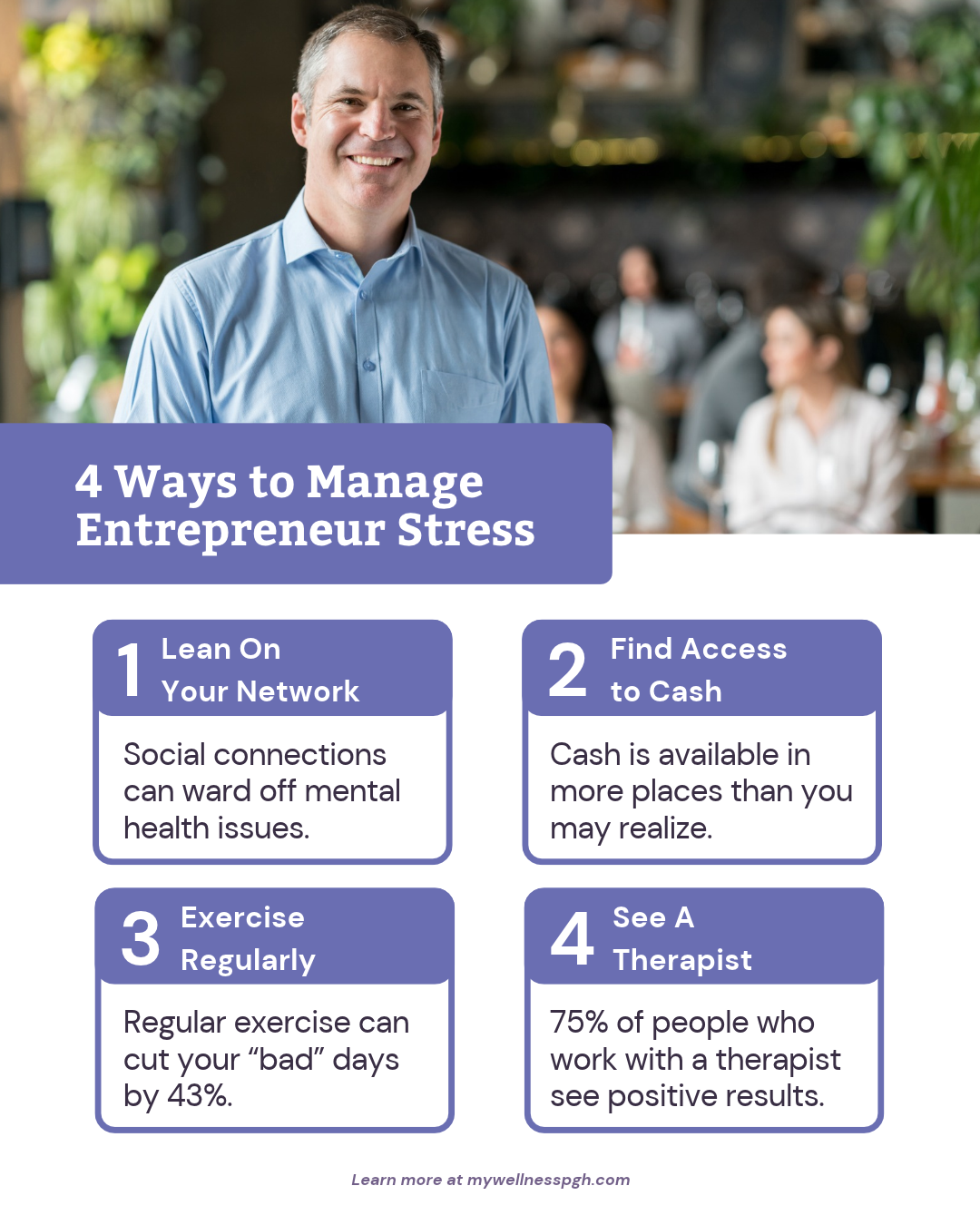
1. Lean On Your Network
In an episode of Entrepreneurs Under Pressure, Alex Lang (co-owner of The Station Inn) offered this piece of advice:
Connect with friends, especially friends who run their own businesses.
Being able to connect, commiserate, and support each other is a critical relief valve that helps him decompress, refocus, and stay on track with his goals while also managing his own stress levels and mental health.
Research shows social connection can ward off depression, mental health issues, and even physical ailments.
2. Find Access to Cash
Since finances are one of the most common small business owner stressors, find different ways to access cash. That could include:
- Support for Payroll – Products like Payro and Gusto have products for when cash flow is tight to help you run payroll even when you don’t have the money right now. While you do need to pay it back quickly, these products can alleviate major headaches.
- Line of Credit – Many banks offer lines of credit to support your business when you need quick, in-the-moment support. While you shouldn’t rely on these lines of credit indefinitely, they can give you a greater financial cushion.
- Access to Loans – There are more loan products out there than you probably realize. In Pittsburgh, for example, Neighborhood Community Development Fund is a nonprofit organization that helps small businesses access much-needed capital.
The idea isn’t to need any of these products. Instead, they’re there as a safety net for when you reach critical points in the business.
3. Exercise
I stay as active as physically possible because it’s critical to my mental health. And I’m not alone in that.
A 2018 study found people can unlock major mental health benefits by:
- Exercising for at least 45 minutes at a time AND
- Exercising at least three to five times per week
Individuals who hit those two goals reported 43.2% fewer days of poor mental health each month!
As a busy entrepreneur, finding time to hit the gym or hop on a stationary bike might feel like an impossibility. But even something as simple as scheduling walking meetings (where you take a walk with your colleagues instead of meeting at a desk) can help you get more movement into your day.
4. See A Therapist Regularly
I see my own therapist each week, and I’ve kept that schedule for years.
For me, keeping that block on my calendar is like a mental safety valve; I know that I’ll have a chance to unburden myself from the things that have been overwhelming me the most in the last seven days.
And I’m not just promoting therapy as a therapist; I’m promoting it as an academic. The data shows 75% of people who attend talk therapy see measurable benefits within six months.
By the way, that’s just talk therapy. Other therapy methods, like EMDR, can show meaningful results in only a few sessions.
Access Mental Health Support for Entrepreneurs
We offer two major strategies for squashing entrepreneur stress:
- Therapy – As we mentioned earlier, meeting with a therapist can significantly boost your mental health (and might even boost your on-the-job performance), so contact us to schedule a consultation!
- Retreats – We’re working on something special: Retreats for small business owners! Keep an eye on our sister company, My Wellness Retreats, for more details in the future!
FAQ: Entrepreneur Stress
How common is stress among entrepreneurs?
Very common. Nearly 88% of entrepreneurs struggle with at least one mental health issue. Half struggle with anxiety, 46% with high stress, 34% with burnout, and 27% feel lonely or isolated. Most business owners don’t talk about it openly.
What are the most common sources of entrepreneur stress?
Three major sources are finances, long hours, and mental drain and insecurity, including self-doubt and self-criticism.
Why are finances such a big stressor for business owners?
Payroll, benefits, real estate, and other major expenses can quickly eat into revenue. A third of business owners have lost sleep worrying about company finances, and a third have put their own money into the business to keep it from closing. Many also face a boom-bust cycle, with record highs some months and record lows in others.
How many hours do small business owners typically work?
According to a study by Inc., 33% of small business owners work at least 50 hours per week, and another 25% work at least 60. Seventy percent regularly work at least one weekend per month. Many of those hours go unpaid, so some owners could earn more working for someone else.
Why do entrepreneurs struggle with self-doubt?
Financial pressure and long hours often lead to thoughts like “I’m not doing enough,” “I’m not as good as my competitors,” or “Do I even want to keep doing this?” About 84% of business owners experience imposter syndrome at least occasionally.