

Article Summary: Believe it or not, your therapist often experiences as much stress as you do; they’re just better at dealing with it. Learn how to manage stress like a therapist so you can focus on living a rich, fulfilling life. Some of the best techniques to use: exercise regularly, see your therapist, take your medication, stay away from drugs and alcohol, and prevent negative emotions from growing too extreme in the moment.
I have a busy schedule. In addition to being a full-time therapist, I also run My Wellness Center and its sister company, My Wellness Retreats. Add three kids at home, regular networking, a dedicated workout routine, and a budding podcast—and you’ve got a calendar that keeps me active.
Unfortunately, that calendar also creates a high level of stress. And I’m not alone; many therapists are stressed or burned out, which is why I’ve dedicated so much time to writing about therapy for therapists and resources for therapist burnout.
Over the years, I’ve developed my own personal strategy for managing stress—and I’m sharing it today. Steal my techniques!
Table of Contents
How I Manage Stress As A Therapist
What Other Therapists Say
Get Therapy for Additional Support
FAQ: How to Manage Stress Like A Therapist
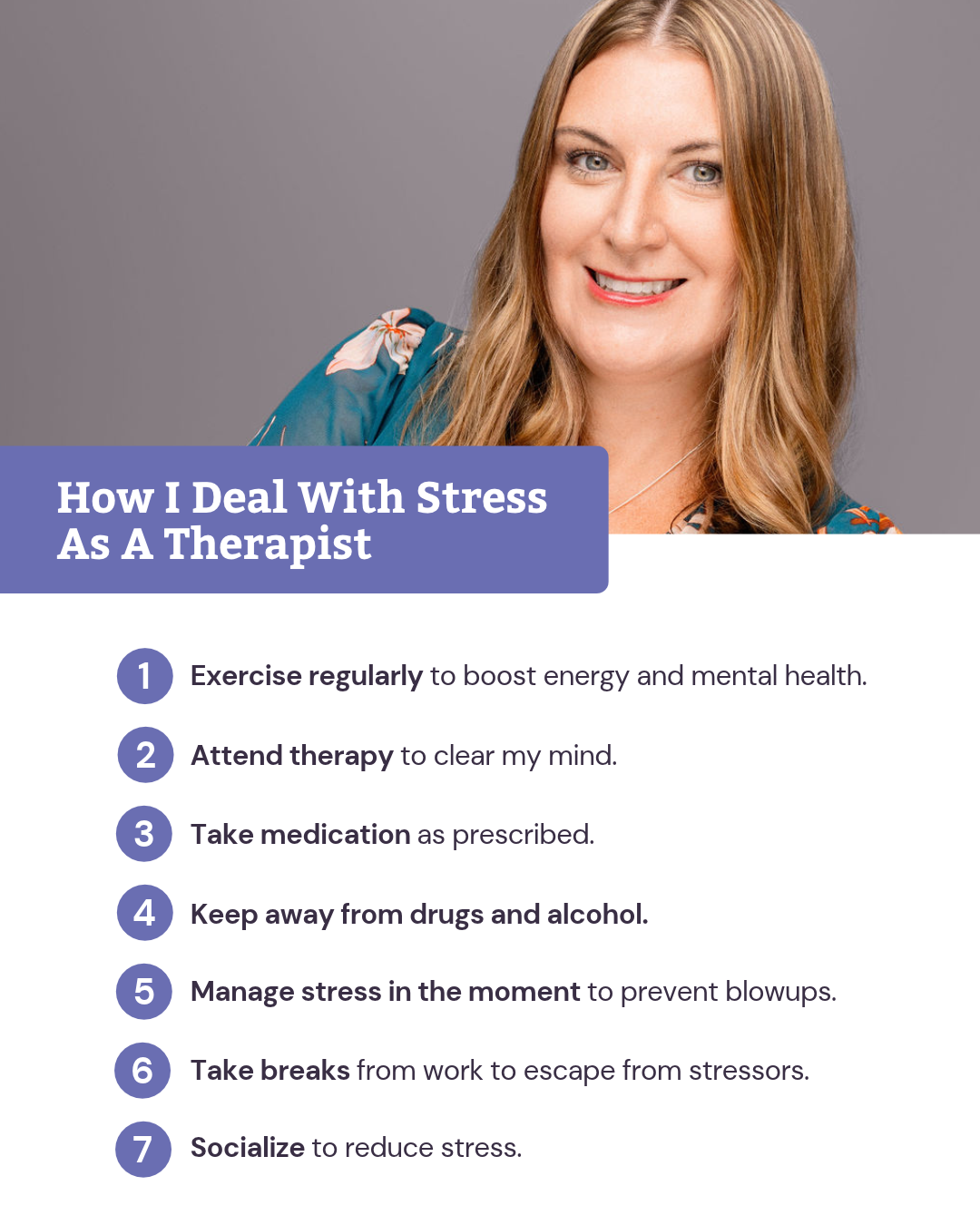
How I Manage Stress As A Therapist
Here are some of my favorite techniques for knocking out stress, both as a therapist and as a business owner:
1. Exercise Regularly
Study after study has shown exercise boosts mental health, and it can directly combat depression, anxiety, and other psychiatric disorders.
I fit perfectly into that research; I’ve learned from personal experience that regular exercise helps me manage stress levels and helps me focus on my busiest, most chaotic days.
My two favorite physical activities:
- Biking – My schedule and responsibilities at home don’t allow me to bike all over Pittsburgh’s North Hills, but I have a Peloton in my home so I can squeeze in a class each morning.
- Yoga – Yoga creates a mind-body connection that I love. Yes, yoga is good for strength and flexibility, but it’s also the mindfulness and breathing that deliver such a powerful mental lift.
The scientific research on yoga is incredibly promising for mental health, with one study concluding:
“The incorporation of deliberate, measured movements, conscious breathing, and mindfulness strategies in yoga exercises facilitates the stimulation of the PNS nervous system, resulting in a state of relaxation. With consistent engagement, yoga has the potential to reshape habitual stress responses, cultivating resilience and emotional balance over time.”
Exercise Tips
Here’s how to get the most out of exercise to benefit your own mental health journey:
1. Find something that works for you. Biking and yoga might be absolutely boring to you. And that’s OK! Instead, find something you enjoy. That could be swimming laps at a local pool, picking up matches at your nearest pickleball court, or hiking your favorite trail.
The important thing is that you find an exercise you enjoy so you can stick to a regular routine—and so that you can get the full mood-boosting benefits.
2. Make it part of your weekly routine. A 2018 study that examined more than 1 million people found the best mental health benefits came from:
- Exercising for at least 45 minutes at a time AND
- Exercising at least three to five times per week
Individuals who hit those two goals reported 43.2% fewer days of poor mental health each month!
Take a look at your calendar. Where can you reliably squeeze in a few workouts each week?
2. See Your Therapist Regularly
I see my own therapist each week, and I’ve kept that schedule for years.
For me, keeping that block on my calendar is like a mental safety valve; I know that I’ll have a chance to unburden myself from the things that have been overwhelming me the most in the last seven days.
And I’m not just promoting therapy as a therapist; I’m promoting it as an academic. The data shows 75% of people who attend talk therapy see measurable benefits within six months.
By the way, that’s just talk therapy. Other therapy methods, like EMDR, can show meaningful results in only a few sessions.
3. Take Your Medication (As Prescribed)
I have ADHD—attention deficit hyperactivity disorder. In plain English: My brain is wired in a way that can make it difficult for me to focus on dull or mundane tasks, but I can hyperfixate on things that naturally interest me, and I can also switch quickly between tasks.
As a business owner, it’s a double-edged sword. Because I’m naturally wired to switch between tasks, I can accomplish many objectives in a single day—but I may also struggle with some of my administrative duties.
While I have many ways of coping with my mind’s shortcomings, I also make sure to take my ADHD medication every day.
Taking my medication as prescribed gives me an additional level of clarity and focus that I don’t feel without my meds, and that makes it easier for me to stay on-task while running back-office responsibilities.
4. Stay Away From Drugs And Alcohol
Alcohol and drugs (especially THC) have a complicated presence in our society. Both are readily available, but both can exacerbate issues.
For me, I stay away from both. At most, I’ll have one or two servings of alcohol when I’m out with friends, but that’s it.
I know, based on my own past and my family’s history, that relying too much on drugs or alcohol could become self-destructive.
And it’s like that for many people—especially with alcohol. After a stressful day, a glass of wine or a cold beer can create a calming, relaxing effect. But regularly relying on alcohol as a coping mechanism can actually increase your baseline anxiety and depressive symptoms.
Research shows a similar issue with long-term cannabis use; regular use can eventually lead to chronic psychotic disorders, and it can even contribute to higher rates of anxiety and depression.
5. Find Ways to Manage Stress In the Moment
There are two different kinds of stress:
- The kind that builds up in the background all day. For me, this is the stress that comes with running a business and seeing multiple clients throughout the day—which is part of the reason I feel so tired by 5:00 PM.
- The kind that spikes inside stressful situations. This is when cortisol rises—and your heart rate and adrenaline levels may rise with it.
While both forms of stress can be dangerous to your immediate and long-term health, it’s especially important to control these sudden, high-intensity stress levels.
Some of my favorite techniques:
- Square breathing – Also known as box breathing, square breathing is a simple breathing technique where you breathe in for four seconds, hold for four seconds, exhale for four seconds, hold for four seconds, then repeat. This relaxation technique calms the nervous system.
- Positive affirmations – I know it may sound cheesy, but I love listening to positive affirmations for a few minutes when I’m feeling especially stressed out. These help me calm down and refocus, and they remind me that I have value and am capable of overcoming whatever challenge is in front of me.
- Vent – Sometimes all I really need is to get some frustrations off my chest. Natalie, our Operations Manager, is a fabulous sounding board for me, even on my busiest, most chaotic days. Outside of work, I meet up with a few friends on a regular basis, and we often use these coffee chats as an opportunity to vent about our biggest issues.
6. Take Breaks
Burnout is dangerous, as I’ve learned the hard way. In fact, I often cycle through burnout every few months.
My favorite solution: I find time to get away.
I love going on retreats with other therapists. Yes, these are valuable for connecting with professionals and earning extra CE credits, but they also give me an opportunity to take care of my mental and physical health away from the office and my domestic responsibilities.
When I’m out of the office and the house, my only responsibility is to take care of myself.
That helps me recharge and refocus.
By the time I return to the office, I’m ready to tackle any problems that come my way!
Research shows frequent vacations reduce exhaustion, improve mood, and increase life satisfaction!
That same study found something critical: To maximize the benefits of vacation, schedule a brief vacation every two months to “mitigate stress accumulation.”
In other words: Get away for a long weekend every two months to help reduce your baseline stress levels.
7. Connect With Others
I regularly connect with friends, therapists (especially through My Wellness Retreats), and fellow business owners to remind myself of an important truth:
I’m not alone.
I even started a fledgling podcast called Entrepreneurs Under Pressure, where I interview other business owners about their worst moments in business.
This regular socialization helps me connect with people who know exactly what I’m going through, and that both energizes me and gives me the confidence to move through my latest challenges.
The research backs this up. Low socialization is as bad as:
- Smoking 15 cigarettes a day.
- Being an alcoholic.
- Not exercising.
Impressively, social interaction can do way more than boost mental health and alleviate depression. It can also:
- Support weight management
- Reduce the impact of diabetes
- Alleviate heart disease
- And more
What Other Therapists Say
I also took some time to interview other therapists at My Wellness Center:
Audrey Wrobel, LCSW
Here’s what Associate Therapist Audrey Wrobel, LCSW, said:
My three favorite stress-management techniques are:
- Movement: I try to incorporate movement consistently throughout my week as a way to buffer the impact of stress. The dedicated time gives me a chance to focus on myself, clear my mind, and take a break from daily responsibilities. Whether it’s going on a run, taking a midday walk, or attending a workout class, I find that making time for movement helps me reset, improve my mood, and feel more grounded.
- Talking to Someone: Sometimes when stress feels overwhelming, it feels really nice to connect with someone. The space gives me a chance to talk through what may be bothering me, be validated in my experience, or just straight up vent. Having someone who will listen and offer support helps me feel less alone in what I’m experiencing. Sometimes, I don’t need someone to solve the problem; I just need to feel heard and reminded that I don’t have to navigate everything on my own.
- Spend Time Outside: Getting outside is one way I try to manage stress and reconnect. I love to grab a cup of coffee and go on a walk, or sit in my backyard on a blanket. Simply getting some fresh air between tasks gives me a chance to ground myself and clear my head.
Kelly O’Connell, LPC, CADC
Here’s what Associate Counselor Kelly O’Connell, LPC, CADC, said:
- Running: Running helps clear my mind daily. It pushes you to your limits while stimulating your endorphin levels, improves your mood, and gives you confidence by proving to yourself that you can reach your goals.
- Cruising: There’s no better way to “unplug” like a good cruise out in the middle of the ocean. Being able to unplug and take my mind off of my daily stressors is best achieved by taking a nice Caribbean cruise.
- My Wellness Retreats: A My Wellness Retreat gives me both time to myself with education and networking opportunities. I get to see the world, regroup, and learn more about topics I’m passionate about that can help me become better for my clients. I get to meet some of the best people and counselors in this world on a My Wellness Retreat.
Get Therapy for Additional Support
As I mentioned earlier, my own therapy sessions have been critical for helping me manage stress, overcome trauma, and keep myself focused even during the busiest, most chaotic weeks.
See whether therapy could be right for you. Contact us to book a consultation.
Our compassionate team is standing by to help you access the care you deserve to manage stress levels and live a happy, fulfilling life.
FAQ: How to Manage Stress Like a Therapist
Do therapists experience stress too?
Yes. Therapists often experience as much stress as their clients; they’re just better at managing it. Many therapists deal with stress and burnout, especially when balancing client work with running a business, family life, and other commitments.
What are the best techniques for managing stress like a therapist?
Key techniques include exercising regularly, seeing a therapist, taking medication as prescribed, avoiding drugs and alcohol, managing stress in the moment, taking breaks, and connecting with others.
How effective is therapy for managing stress?
Data shows 75% of people who attend talk therapy see measurable benefits within six months. Other methods, such as EMDR, can show meaningful results in only a few sessions. Regular therapy acts as a “mental safety valve,” a dedicated time to unload whatever has been most overwhelming.
Why is social connection important for stress management?
Connecting with people who understand what you’re going through can be energizing and build confidence. Research shows low socialization is as harmful as smoking 15 cigarettes a day, being an alcoholic, or not exercising. Social interaction can also support weight management, reduce the impact of diabetes, and help alleviate heart disease.