

Article Summary: Many of our EMDR clients have the same question: “How long does EMDR take for complex trauma?” Although the answer varies from person to person, EMDR can fully address complex trauma in as few as 6–12 sessions.
Trauma is frustrating. Even after you’ve removed yourself from a threatening situation and you know you’re safe, the emotional and psychological pain continues.
That leads us to an unfortunate truth: We can talk about an issue all day in therapy, but none of it matters if we don’t address the wound.
In other words: Therapy takes work to destroy trauma, especially complex trauma, at the source.
And that’s why EMDR for complex trauma is so powerful. EMDR rewires how your brain accesses painful memories, creating permanent relief.
Table of Contents
What Is EMDR?
EMDR and Complex Trauma
How Long Does EMDR Take For Complex Trauma?
Find An EMDR Therapist for Complex Trauma
FAQ: EMDR With Complex Trauma
What Is EMDR?
EMDR stands for Eye Movement Desensitization and Reprocessing. It was first developed at the Mental Research Institute in the 1980s, and it works by activating the entire brain to process and reorganize intense emotions, memories, and traumas.
In simple terms, EMDR uses bilateral stimulation (alternating sensory inputs) to change how we access the painful memories. Instead of forcing us to recall hurtful moments with anxiety or dread, it allows us to review them like distant photographs.
In other words, EMDR therapy allows us to remove the pain from our most destructive memories.
It sounds like science fiction, but the proof is in the research:
- PTSD symptoms were eliminated in 84%-90% of single-event trauma victims after only three 90-minute EMDR sessions, according to research in The Permanente Journal.
- Symptoms were reduced or eliminated in 77% of multiple-trauma victims after only six 50-minute EMDR sessions, according to Texas Tech University Health Sciences Center.
- PTSD symptoms were eliminated among 77% of combat veterans in 12 EMDR sessions with their therapist, according to research in Frontiers In Psychology.
EMDR and Complex Trauma
Complex trauma is different from a single traumatic event. Instead of one isolated experience—like a car accident or natural disaster—complex trauma develops over time through repeated exposure to stressful, frightening, or harmful situations.
This is why we often see complex trauma in:
- Survivors of childhood abuse or neglect, including adoptees
- Individuals raised in chaotic or unpredictable homes
- Victims of domestic violence
- First responders
- Healthcare workers
- Military personnel
Unlike single-event trauma, complex trauma often becomes woven into a person’s identity, relationships, and worldview. It can affect:
- self-esteem
- emotional regulation
- trust
- physical health
Here’s the good news: EMDR can help.
EMDR is uniquely suited to address complex trauma because it helps identify and process entire networks of painful experiences that may be contributing to present-day symptoms.
For example, someone who grew up in an abusive household may not have one defining traumatic memory. Instead, they may have hundreds of smaller experiences that taught them they weren’t safe, valued, or worthy of love.
Through EMDR, these experiences can be processed one by one—or through connected themes—allowing the brain to reclassify them as events that happened in the past rather than threats that still exist today.
As these memories lose their emotional charge, many clients experience improvements in:
- anxiety
- self-confidence
- relationships
- sleep
- overall quality of life
The results can be truly astounding, especially when they’re displayed visually in a brain scan:

A slide from a recent EMDR training session we attended. The first image is of a brain scan from a woman suffering from PTSD, with the red areas highlighting areas of PTSD-induced overactivity. The second image shows significantly reduced overactivity—after only four 90-minute EMDR sessions. (Slide Credit: Maria Travisio)
Some of My Personal Experiences With EMDR and Complex Trauma
I’ve personally discussed some of my own traumas through this blog and our social media channels (Follow us on Facebook and Instagram!), and EMDR has been essential for helping me grow and develop.
From personal experience, I know that EMDR gives me relief from my emotions during the day and even stops nightmares—my dreams are much easier to cope with since undergoing EMDR therapy.
Most importantly, though, EMDR has helped me come to terms with moments in my past. Instead of reliving my most painful memories with anger, guilt, frustration, or sadness, I’m able to think about them analytically—and still maintain control of my emotions in the present.
Related Reading: Post-Traumatic Resilience: How to Develop Strength After Trauma
How Long Does EMDR Take For Complex Trauma?
The number of sessions required varies from person to person. While military members, first responders, and nurses often suffer from layers of trauma, anyone can have complex trauma.
And everyone requires a different number of EMDR sessions.
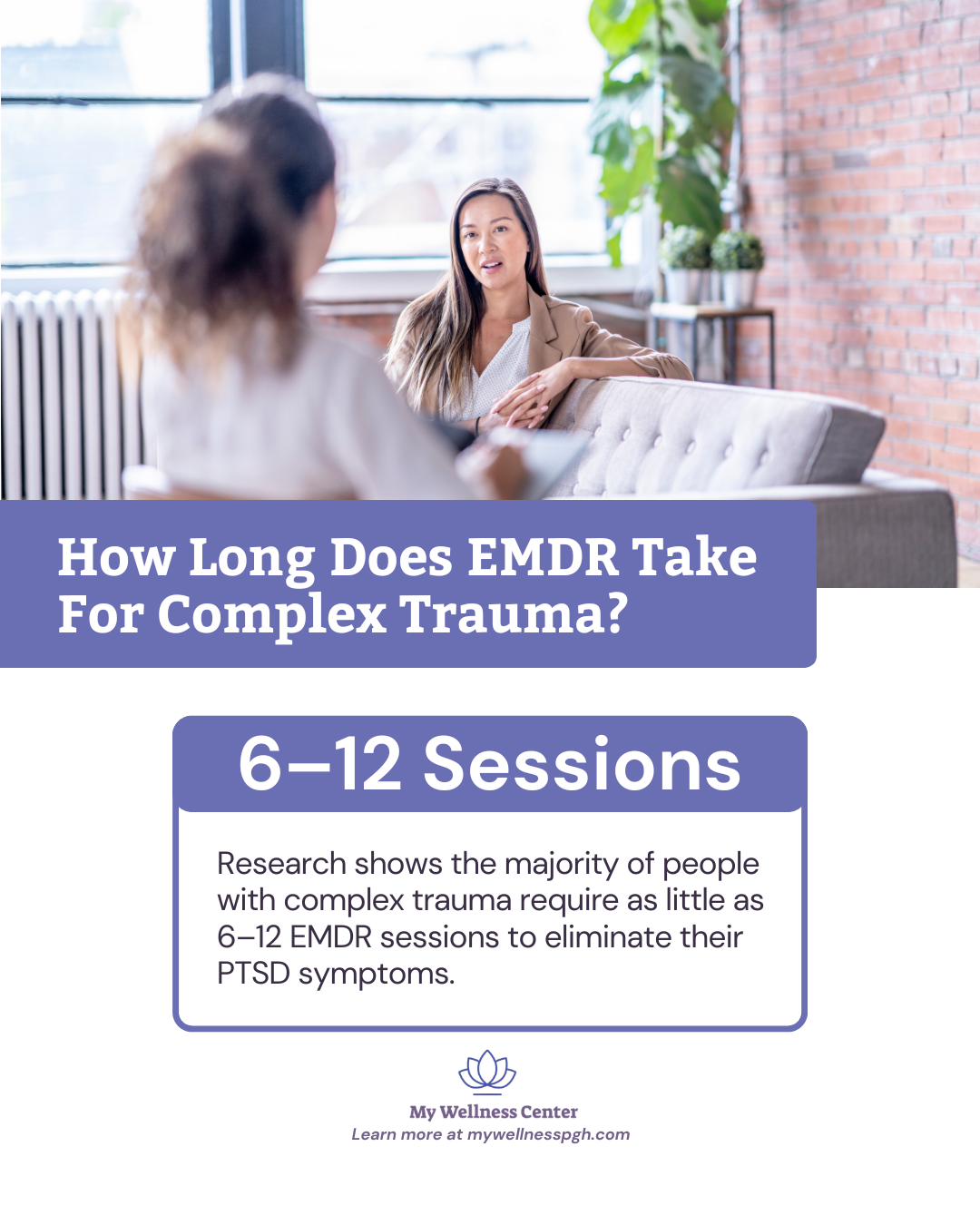
Research suggests the majority of people with complex trauma require 6–12 EMDR sessions to eliminate symptoms of PTSD.
Depending on how frequently you’re undergoing EMDR therapy, that could be as few as 6–12 weeks (assuming one session per week).
Find An EMDR Therapist for Complex Trauma
Our team is filled with therapists who specialize in EMDR, and many of them have gone well beyond the bare minimum; some even have their EMDRIA Certification from the EMDR International Association, which requires ongoing continuing education credits and deeper training.
Of course, you can also find other specialized EMDR therapists. For example, some specialize in:
- Addiction
- Adoption
- Complex Trauma
- And more
Contact us for help finding the ideal EMDR therapist for your specific needs. We can even offer online EMDR therapy!
FAQ: EMDR With Complex Trauma
What is EMDR therapy?
EMDR (Eye Movement Desensitization and Reprocessing) is a trauma-focused therapy that uses bilateral stimulation to help the brain process and heal painful memories.
Can EMDR treat complex trauma?
Yes. EMDR is widely used to treat complex trauma and PTSD by helping individuals process multiple traumatic experiences and reduce their emotional impact.
How long does EMDR take for complex trauma?
Every person is different, but research suggests many individuals experience significant improvement within 6–12 sessions. More severe or long-standing trauma may require additional sessions.
What does EMDR feel like?
Many people describe EMDR as surprisingly natural. Memories may become clearer at first, but over time, they often feel more distant, less emotional, and easier to discuss.