

Article Summary: Praying and meditating both offer health benefits by soothing the mind, boosting physical health, and reducing anxiety. Although they are slightly different, decades of research show they’re both beneficial.
As a team of therapists, we’re rooted in research-backed techniques and the latest scientific findings.
But even though we believe in the scientific method, we also realize an important truth: prayer and meditation—two of the oldest, most mysterious traditions in human history—offer incredible health benefits.
That’s not our opinion; instead, countless scientific research studies have shown both prayer and meditation can calm the mind and enhance overall physical well-being.
Continue reading to learn more:
Table of Contents
What’s the Difference Between Praying And Meditating?
What Is Praying?
What Is Meditating?
Benefits of Praying And Meditating
Benefits of Praying
Benefits of Meditating
FAQ: Praying And Meditating
Note: Although My Wellness Center is not a religious organization, we support all religious creeds and belief systems. For this article, we’ve approached prayer from a strictly scientific perspective.
What’s the Difference Between Praying And Meditating?
To understand the differences between praying and meditating, we must first understand what each one is.
What Is Praying?
In its simplest terms, prayer is communication with a higher power.
While the definition and forms of prayer can vary from religion to religion, we generally find prayer in forms of:
- Adoration and praise (like singing or attending a church service)
- Thanksgiving (expressing gratitude)
- Intersession (praying for the benefit of our loved ones, communities, and others)
- Petition (requests for help in our personal lives)
While different from meditation, it shares a few similarities—as we’ll explore next:
What Is Meditating?
Meditation is the practice of controlling your attention and awareness to work toward a clearer, calmer mind.
Many people think of meditation as the difficult task of “emptying your mind”—but that’s rarely the case. Instead, most meditation revolves around observing your thoughts and physical sensations without judgment, and simply allowing them to pass through.
Meditation can also be guided, either with an in-person trainer or even via a YouTube video or mobile app.
Either way, the intended result is the same: a calmer mind with greater clarity.
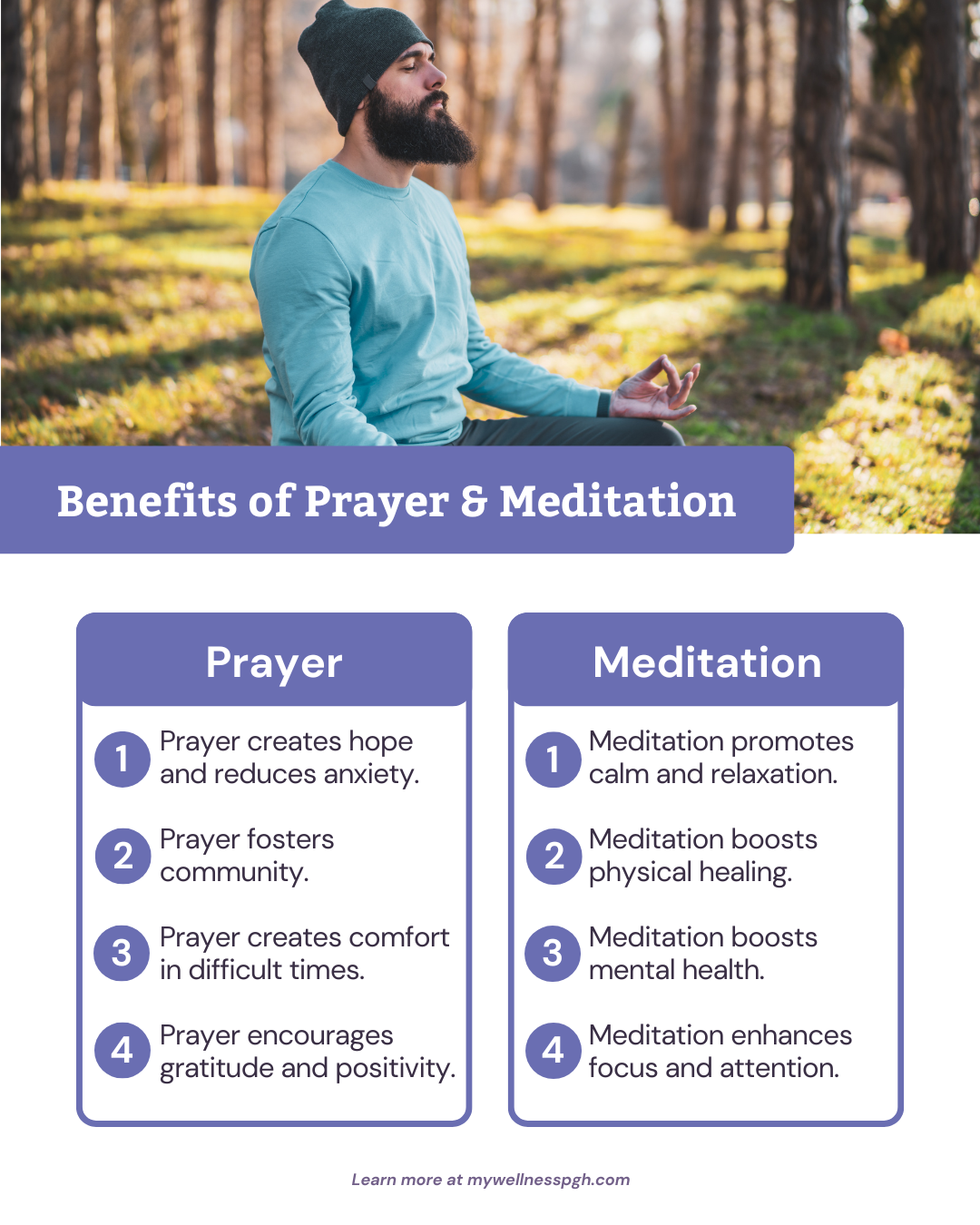
Benefits of Praying And Meditating
Both prayer—in its many forms—and meditation can have incredible, wide-reaching benefits to your body and mind.
Here’s how each one can offer a quick, sustained boost to your health:
Benefits of Praying
1. Prayer creates hope—and reduces anxiety. Research shows that both prayers of praise and even faith itself can contribute to lower anxiety levels.
2. Prayer is community. Organized prayer—like attending Sunday mass or a faith-based retreat—can help us deepen our connections with the people around us, fostering a sense of community.
That’s a big deal. Research from the World Health Organization shows that meaningful social connections can:
- Reduce inflammation
- Lower the risk of serious health problems
- Boost mental health
- Prevent early death
3. Prayer creates comfort. There’s a reason families gather around their dying loved ones to join in prayer: The act of praying is soothing in difficult emotional times.
Although prayer doesn’t always change the outcome, it can foster a sense of acceptance and peace.
This is true at all times—not just while our loved ones are on their deathbeds.
4. Prayer encourages gratitude and positive thinking. Many forms of prayer involve expressing gratitude for the people, opportunities, and blessings in our lives.
Research shows gratitude practices can have significant health benefits, including:
- boosting emotional wellbeing
- increasing resilience
- reducing stress
- improving heart health
By regularly focusing on what is going right instead of what is going wrong, prayer can help cultivate a more hopeful and optimistic outlook with major health benefits.
Benefits of Meditation
I know from personal experience just how beneficial meditation can be; I often say I’m at my best when I regularly meditate at least 10 minutes a day.
But don’t take my word for it. Here’s what the research says:
1. Meditation promotes calm and relaxation. The Mayo Clinic puts it simply:
“Meditation can give you a sense of calm, peace and balance that can benefit your emotional well-being and your overall health.”
2. Meditation helps healing on a cellular level. Believe it or not, research shows meditation can:
- Improve the immune system
- Reduce inflammation
- Support healthy aging
- Benefit treatment for diabetes, hypertension, and fibromyalgia
- Reduce unhealthy cholesterol levels
- Improve blood pressure
3. Meditation boosts mental health. Regular meditation can have extensive benefits for mental health, offering support for:
4. Meditation improves focus and attention. Meditation isn’t just about relaxation—it can also strengthen your ability to concentrate.
Multiple studies have found that regular meditation improves attention, reduces mind-wandering, enhances working memory, and strengthens executive functioning.
In practical terms, this can make it easier to stay focused at work, school, and home while remaining more present in everyday life.
FAQ: Praying And Meditating
What’s the difference between praying and meditating?
Prayer is generally a form of communication with a higher power, while meditation is the practice of focusing your attention and awareness to cultivate a calmer, clearer state of mind.
Can prayer and meditation be practiced together?
Absolutely. Many people combine prayer and meditation, using prayer to communicate with a higher power and meditation to listen, reflect, and develop greater awareness.
What are the mental health benefits of prayer?
Research suggests prayer may help reduce anxiety, increase hope, encourage gratitude, provide comfort during difficult times, and strengthen social connections through faith communities.
What are the mental health benefits of meditation?
Meditation has been linked to reduced stress, lower anxiety, improved emotional regulation, enhanced focus, and support for conditions such as PTSD and depression.