

Article Summary: A death doula is a compassionate professional who assists people as they prepare to pass away. Many death doulas specialize in creating a safe, calm environment where individuals can finally accept their own mortality. With the doula’s help, individuals can pass away with dignity.
Most of us are familiar with the idea of a doula from the process of childbirth: Doulas are people who provide physical, emotional, and informational support before, during, and after birth.
But we’re now seeing a rise in death doulas—individuals who provide similar levels of physical, emotional, and informational support during the dying process.
We recently interviewed Associate Therapist Jess Schiermeister, LSW, MSW, a former palliative care social worker, to learn more about death doulas and the value they provide.
Related Reading: Pittsburgh Grief Therapy
Table of Contents
What Is A Death Doula?
What Does A Death Doula Do?
What Kind of Issues Can A Death Doula Help With?
Tips for End of Life
Find A Pittsburgh Death Doula
Death Doula FAQs
What Is A Death Doula?
A death doula is an advocate for a person who is dying.
A compassionate death doula offers emotional support and a calm, neutral third-party to discuss fears, apprehensions, and concerns about passing away. In some cases, a doula can even offer guidance in preparing for overwhelming end-of-life care and finalizing estate decisions.
“The most important thing is to provide emotional support,” says Schiermeister, “regardless of where they are in their own grieving process. Because we treat death as a taboo topic in the US, not everyone has someone to talk to about dying. A doula provides that outlet.”
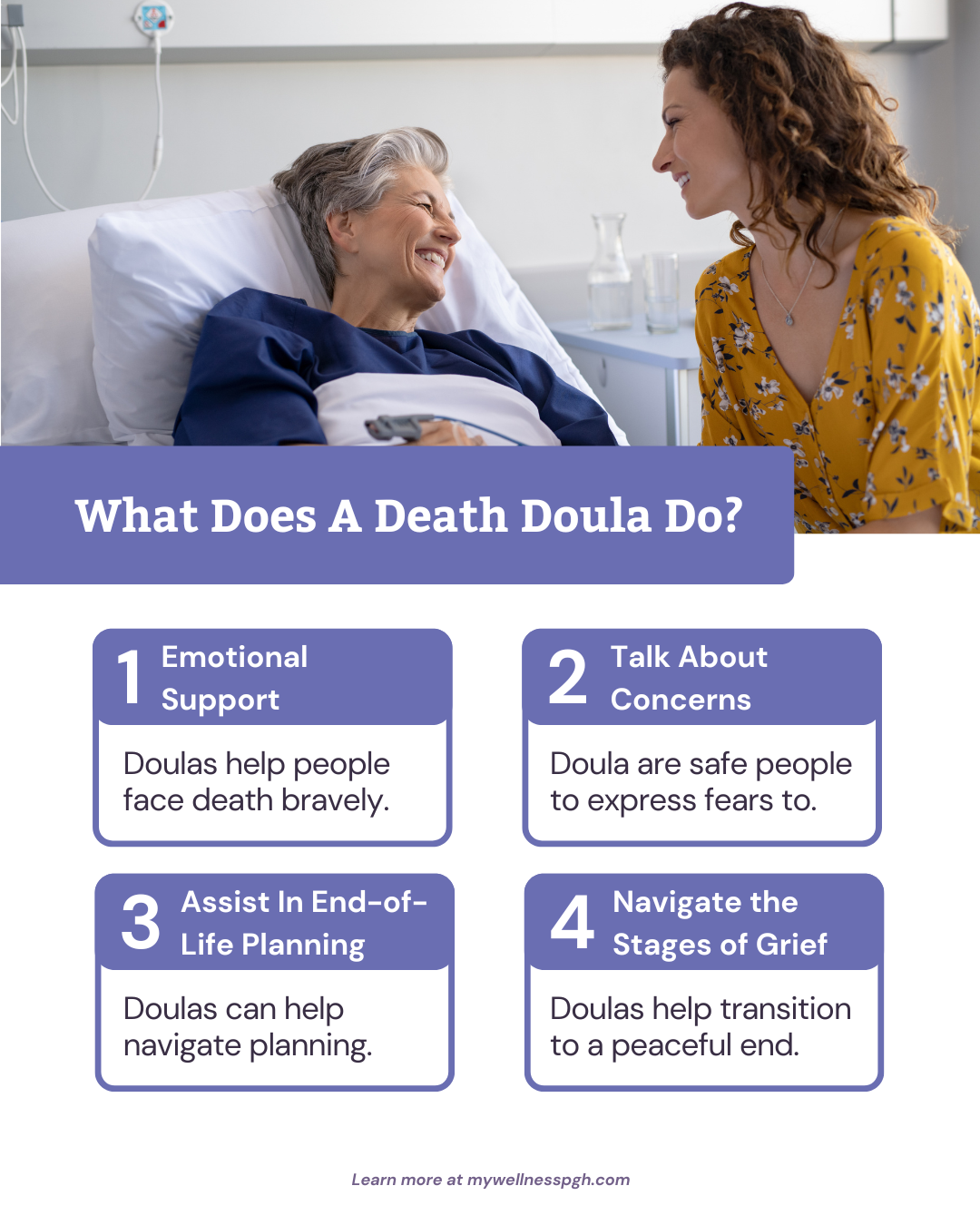
What Does A Death Doula Do?
A death doula has a few responsibilities as someone prepares to pass away. A few of their biggest task include:
1. Provide Emotional Support
For most people, death is a daunting, terrifying event. A death doula provides a calm presence—even if the individual doesn’t want to talk.
Under the best circumstances, a death doula has therapy training—like Schiermeister—to provide additional tools and resources to bolster emotional health and even move toward full acceptance of death.
2. Talk About Concerns
As Schiermeister mentioned, not all families are comfortable talking about death, which can make the transition more difficult for those who are passing away.
A death doula is a compassionate individual who can discuss the dying process, and can touch on topics such as:
- Regrets
- Fears of the unknown
- Religious beliefs
- Medical worries
- Legal issues
- And more
3. Assist In End-of-Life Planning
Although most death doulas aren’t medical professionals or attorneys, they can often add much-needed perspective and guidance to ensure all decisions are made ahead of death. This could include:
- Medical concerns—such as whether or not to be placed on life support or to be resuscitated
- Legal issues—such as who inherits your belongings after death
- Your funeral, burial, and memorial service
4. Help Navigate the Stages of Grief
Death doulas can also help individuals and families navigate the five stages of grief:
- Denial
- Anger
- Bargaining
- Depression
- Acceptance
While not everyone experiences these stages in the same order—or even experiences all of them—a death doula provides emotional support throughout the process, helping people feel seen, heard, and understood.
This support can be especially important near the end of life, when unresolved grief, fear, or anger may become overwhelming. By creating a safe environment for honest conversations and emotional expression, a death doula can help individuals and families move toward greater peace, acceptance, and emotional closure.
What Kind of Issues Can A Death Doula Help With?
A death doula can assist with all issues related to end-of-life planning, especially when it comes to approaching these responsibilities in a calm, mature manner. Areas where a death doula can assist or provide perspective include:
1. Estate Planning
A death doula is not an estate planner, but they can offer an unbiased voice in the estate planning process and encourage you to make the necessary decisions to ensure your family and affairs are taken care of before you pass away.
2. Medical Decisions
Your death doula can also help you navigate the complex medical questions at the end of life. And, ideally, they’ll help you develop a game plan before it’s necessary.
Ideally, you should determine:
- Life-saving medical treatments you do want—if necessary.
- Life-saving medical treatments you don’t want—even if it means you’ll pass away.
For example, some people may decide they never want to be intubated or go onto a respirator. Instead, they’d prefer to pass away without having their life assisted by machines.
Not having these conversations while you’re still lucid could later backfire, as Schiermeister points out. “When I was working in palliative care, there was one patient who told us, the hospital workers, that she didn’t want certain treatments.
“But when she fell unconscious, a member of the family became the medical decision maker. This decision maker chose many treatments the woman never wanted but had never told her family. We had to oblige; we did things we knew she didn’t want, but we didn’t have a choice.”
3. Therapy & Mental Health
A death doula also serves as a welcoming, nurturing voice in one of life’s most difficult transitions.
And that’s important, because not everyone wants to talk about death. “The US isn’t very death-positive,” Schiermeister says. “It’s such a taboo topic, and nobody wants to talk about it—not even family members. But talking about it is healing, and that healing can help you pass away truly at peace.”
Schiermeister has seen the worst when someone refuses to talk through their emotions late in life: “When I worked in palliative care, I watched one woman die alone because she was so angry. She never reached the ‘acceptance’ stage of her grief, and when she was moved to hospice, she refused to let her family see her. She died miserable and alone.”
But it’s not just talking that’s important; tried-and-true therapy techniques can be especially useful late in life. Schiermeister frequently encourages radical acceptance—the practice of fully accepting reality without resistance.
Tips For End Of Life
If you’re struggling with approaching the end of your own life, you’re not alone.
We’re here to help.
Here are some of Schiermeister’s best tips:
1. Find someone to talk to. Talk about everything: your fears, your anxieties, the experience of shifting through doctors, nurses, and medical systems. Talk about the tough conversations you’re having with family members.
A death doula provides that safe, neutral sounding board to get the biggest concerns off your mind and work toward acceptance.
2. Have someone who can help with logistics. You have some big questions to answer at the end of your life:
- Who inherits your property?
- How do you want your funeral to go?
- What do you want your end-of-life medical care to be like?
Find someone or multiple people who can help you navigate your options and who can help advocate on your behalf.
3. Celebrate the dead. “I’ve always been a fan of Dia De Los Muertos,” Schiermeister says. “A funeral should really be a celebration of life—not a prolonged period of mourning.”
By flipping the script while you’re alive, you can start to accept death as a natural part of life—and as an opportunity to celebrate the people who came and went before us.
“This is why language is so important,” Schiermeister adds. “Calling a funeral a ‘funeral’ is inherently bleak. But calling it a ‘memorial service’ or a ‘celebration of life’ gives friends and family an opportunity to approach the event with a sense of joy or even relief.
Find A Pittsburgh Death Doula
If you’re looking for a Pittsburgh death doula, contact us. We’ll connect you with a therapist who can help you live your final days with grace and dignity while simultaneously preparing your family for your passing.
Death Doula FAQs
What is a death doula?
A death doula is a compassionate professional who provides emotional, practical, and informational support to individuals and families during the dying process.
What does a death doula do?
Death doulas help individuals talk through fears, navigate end-of-life decisions, process emotions, and create a calm, supportive environment during their final stage of life.
Is a death doula the same as hospice care?
No. Hospice care focuses on medical care and pain management, while a death doula focuses on emotional support, advocacy, planning, and companionship.
Can a death doula help with grief and anxiety about dying?
Yes. One of the primary roles of a death doula is helping individuals process fears, grief, anxiety, and emotional concerns surrounding death and mortality.
Do death doulas provide medical or legal advice?
Typically, no. Death doulas are not usually medical professionals or attorneys, but they can help individuals better understand their options and communicate with healthcare or legal professionals.