

Article Summary: Therapy for young adults is critical for overcoming the rampant levels of anxiety and depression we’ve seen in adults aged 18–29. Although these mental health issues are commonly caused by societal issues, they can be overcome through a dedicated locus of control and consistent therapy to make meaningful changes in life.
You are not alone.
Those four words grace our homepage for one important reason: It’s true.
That doesn’t feel like reality when you’re navigating the harsh truths of adulthood.
After all, young adults all over the country are managing uncomfortable rates of depression and anxiety—often on a daily or weekly basis.
We sat down with Associate Counselor Pat McGowan, LPC, NCC, to get his perspective on therapy for young adults.
Table of Contents
Common Mental Health Issues In Young Adults
Societal Challenges for Young Adults
Therapy for Young Adults: Tactics That Work
Find Therapy For Young Adults
FAQ About Therapy For Young Adults
Common Mental Health Issues In Young Adults
The two biggest issues we see over and over for adults 18–29 are:
- Anxiety/Panic
- Depression
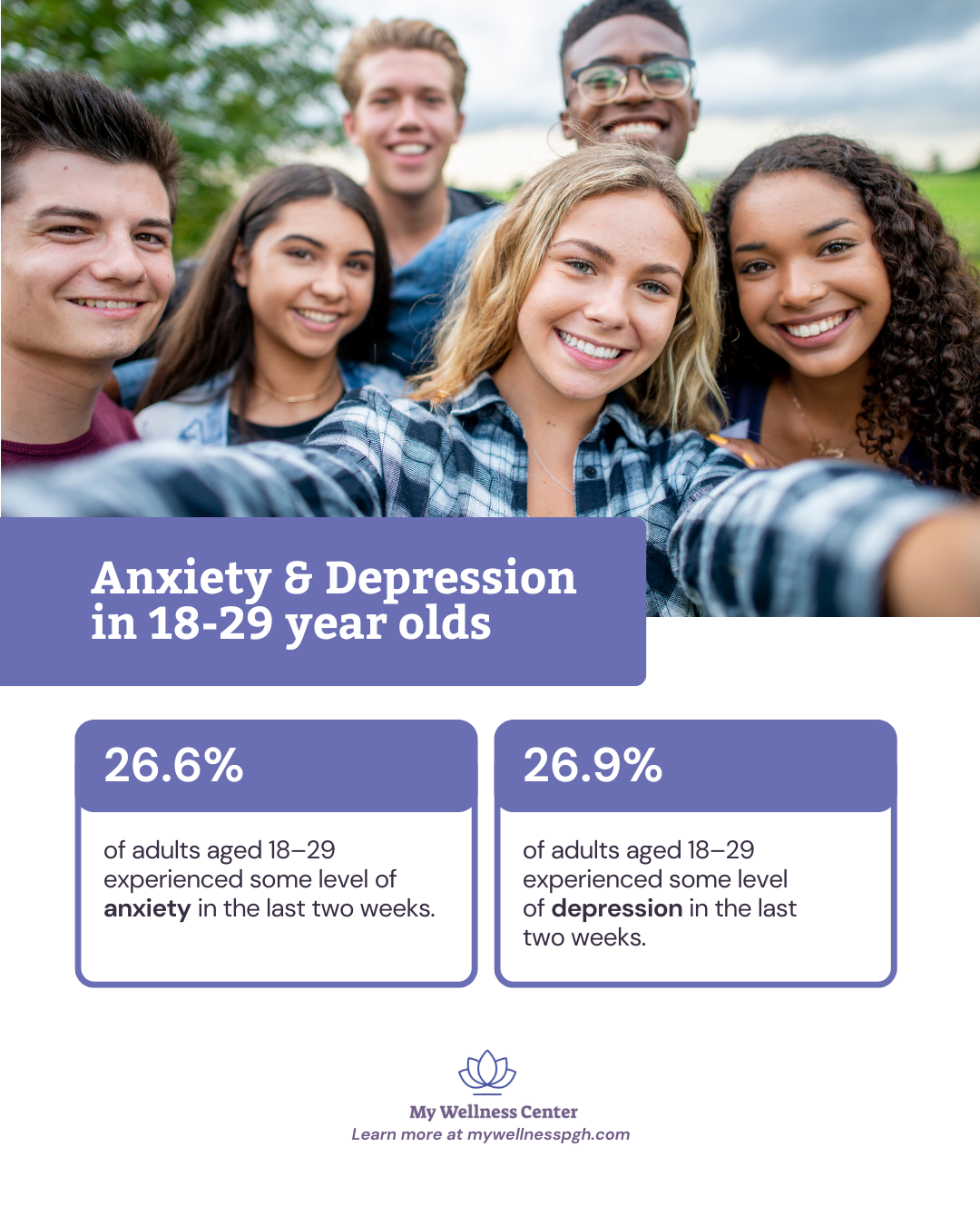
And the research supports that. A 2022 National Health Interview Survey found two startling facts:
- 26.6% of adults aged 18–29 experienced some level of anxiety in the last two weeks.
- 26.9% of adults aged 18–29 experienced some level of depression in the last two weeks.
With the focus on only the last two weeks, the larger message is clear: This age group is currently experiencing rampant mental health issues.
Related Reading: Teen Therapy: What You Should Know
Societal Challenges for Young Adults
From what we’ve seen, this age range is currently suffering from a general sense of hopelessness. It’s not hard to see why:
- Approximately 25% are underemployed.
- Nearly 43% of college graduates are underemployed.
- As many as 25% could soon be unemployed.
In addition, real estate prices have skyrocketed, our country is facing major divides internally and internationally, and the costs of goods and services have continued to rise out of reach.
For many of them, life isn’t going the way they’d planned—and they can’t see a clear path to achieving their goals.
“It’s like the ladder has been pulled up on this generation,” Pat McGowan says. “The game of life has gotten more and more difficult, and people feel locked into place… They’re frustrated that they don’t have a clear path forward.”
And that’s not to say life has never been difficult for young adults. “I was rejected from a job at Blockbuster during the 2008 housing crisis,” Pat McGowan says. “And an old timer might say the Great Depression was 10 times worse than this.”
But that doesn’t change the fact that what you feel right now is real and valid. This is a different reality than most people have lived, and it’s challenging to navigate through it.
Therapy for Young Adults: Tactics That Work
“There are larger factors we can’t solve,” Pat McGowan says. “We can’t solve the job market or the economy. But we can solve the problem in ourselves.”
Some of the tactics Pat McGowan has found while working with his own clients:
1. Validate Your Anxiety And Worry
First, recognize this: If you’re suffering from anxiety or depression, that’s OK. There’s nothing wrong with you. Your body and mind are simply responding to the world and conditions around you.
You’re not alone in this journey.
2. Manage Emotions
Overcoming anxiety and worry doesn’t happen overnight, so it’s important to find ways to manage your emotions and physical symptoms.
This could include:
- Box Breathing Exercises
- Grounding Exercises
- Physical Exercises to Manage Hormones and Emotions
You’ve likely already developed a few healthy coping mechanisms that work for you. If you haven’t tried some of the actions in the list to find something that fits!
3. Understand What Happiness Really Looks Like
Let’s get something out of the way: Happiness is a commonly misunderstood emotion—and it’s different for everyone.
Happiness isn’t what your mom or dad told you it was when you were a kid. And it’s not living the life of your most successful friend. And it’s not chasing after the lifestyle of your favorite star or social media celebrity.
“I see people often describe happiness in a single domain,” Pat McGowan says. “I’ll be happy when I have this job. I’ll be happy when I have a child. I’ll be happy when I’m making this much money.”
But happiness isn’t reaching goals. It’s a fleeting moment surrounded by general feelings of contentedness. It’s the ability to pursue your passions with the freedoms and abilities you have.
“In mathematical terms,” Pat McGowan says, “happiness is when you have more good days than bad days.”
4. Spur Your Anxiety and Worry Into Action
At their core, depression, panic, and anxiety are signals of lurking danger—either the traumas of the past or the threats of the future.
Either way, one of the best ways to overcome these hazards is to take meaningful action to improve your life’s circumstances.
“I often recommend finding a mantra that you find inspirational—something beyond, ‘It’s going to be OK,’” Pat McGowan says. “One mantra I personally come back to time and time again: If you’re going through hell, keep going.”
The important thing is to remind yourself that we’re going to continue working until we find a solution.
5. Stick With It
Change doesn’t happen overnight. Instead, it can take weeks, months, or even years of dedicated focus to make meaningful changes in life.
Even more frustrating: An idea, concept, or strategy can sound great during a therapy session—only for negative self-talk to derail progress a few days later.
That’s why consistent intentionality is so important. Change is hard. But staying unhappy is even harder.
I don’t like to make timeline predictions because everyone is different, but here’s a rough timeline of where people often land:
- Phase 1 (Months 1–3): Usually, with a few months of consistent intentionality, we see a small, general improvement in mood, optimism, and overall circumstances.
- Phase 2 (Months 3–6): This is when the change starts to feel real. Thanks to that emboldened internal locus of control (the belief that you control your own destiny), the momentum starts to shift.
- Phase 3 (Months 6–12+): In Phase 3, life starts to feel managed—or at least manageable. In most cases, clients have made considerable progress in life and in managing their mental health.
To be clear, every journey is different. You’ll occasionally hit roadblocks, and they’ll set you back a few weeks.
The important thing is to remain focused, repeat your mantra, and continue on your path.
Find Therapy For Young Adults
We’ll end on a message of hope: Happiness is real.
If you’ve felt it once, you can feel it again. It still exists; we just need to figure out how to access it.
That’s where we can help. Our team of dedicated, compassionate therapists is standing by to lend you support.
Contact us to get started.
FAQ About Therapy For Young Adults
Is therapy helpful for young adults?
Yes. Therapy can provide young adults with the tools, support, and perspective needed to manage anxiety, depression, and major life transitions more effectively.
What issues do young adults typically discuss in therapy?
Common topics include anxiety, depression, career uncertainty, relationships, identity, financial stress, and navigating major life decisions.
How do I know if I need therapy?
If you’re feeling overwhelmed, stuck, anxious, depressed, or unsure about your direction in life, therapy can help you better understand your thoughts and develop a path forward.
What happens during a therapy session?
Therapy sessions are conversations in a safe, confidential space where you can explore your thoughts, emotions, and challenges while working with a therapist to build practical coping strategies.
How long does therapy take to work?
It varies for everyone, but many young adults begin to notice small improvements within a few months, with more meaningful progress over time through consistent effort.
Is it normal to feel anxious or depressed in your 20s?
Yes. Many young adults experience these feelings due to life transitions, societal pressures, and uncertainty about the future—but that doesn’t mean you have to handle it alone.