

A few decades ago, Autism Spectrum Disorder was hardly understood. But today, it’s discussed more than ever, and it’s even become the focal point of popular TV shows like the coming-of-age tale in Atypical, the reality TV of Love on the Spectrum, and the medical drama of The Good Doctor.
While the hard-hitting storylines of these shows have helped to educate the public about what living with Autism Spectrum Disorder is like, they don’t always reflect everyone’s true, lived experiences.
That’s why therapy for adults with autism is so important. Therapy is a lifeline to help individuals understand past traumas, develop new social skills, and navigate a society that is often confusing, abrasive, and even intimidating.
Table of Contents
Therapy for Adults With Autism FAQ
What is Autism Spectrum Disorder?
How many people have autism?
Why is therapy important for adults with autism?
What are the signs of autism in adults?
What is high-functioning autism in adults?
What happens in therapy for adults with autism?
Find A Therapist For Adults With Autism
Therapy for Adults With Autism FAQ
Here are some of the most common questions we hear about adults and autism:
What is Autism Spectrum Disorder?
In simple terms, autism spectrum disorder is a condition that affects how people interact, communicate, and behave. In most cases, individuals on the spectrum experience difficulties with social skills, developing new interests, and repetitive behaviors.
Because autism is a spectrum, no two cases are exactly alike.
Some individuals with ASD are highly intelligent, and some live with learning disabilities. Some hold highly demanding jobs, and some don’t work. Some seem to “fit in” perfectly fine, and others “stand out” because of uncontrollable repetitive actions or sensory-seeking behaviors.
Related Reading: Therapy for Parents of Special Needs Children
How many people have autism?
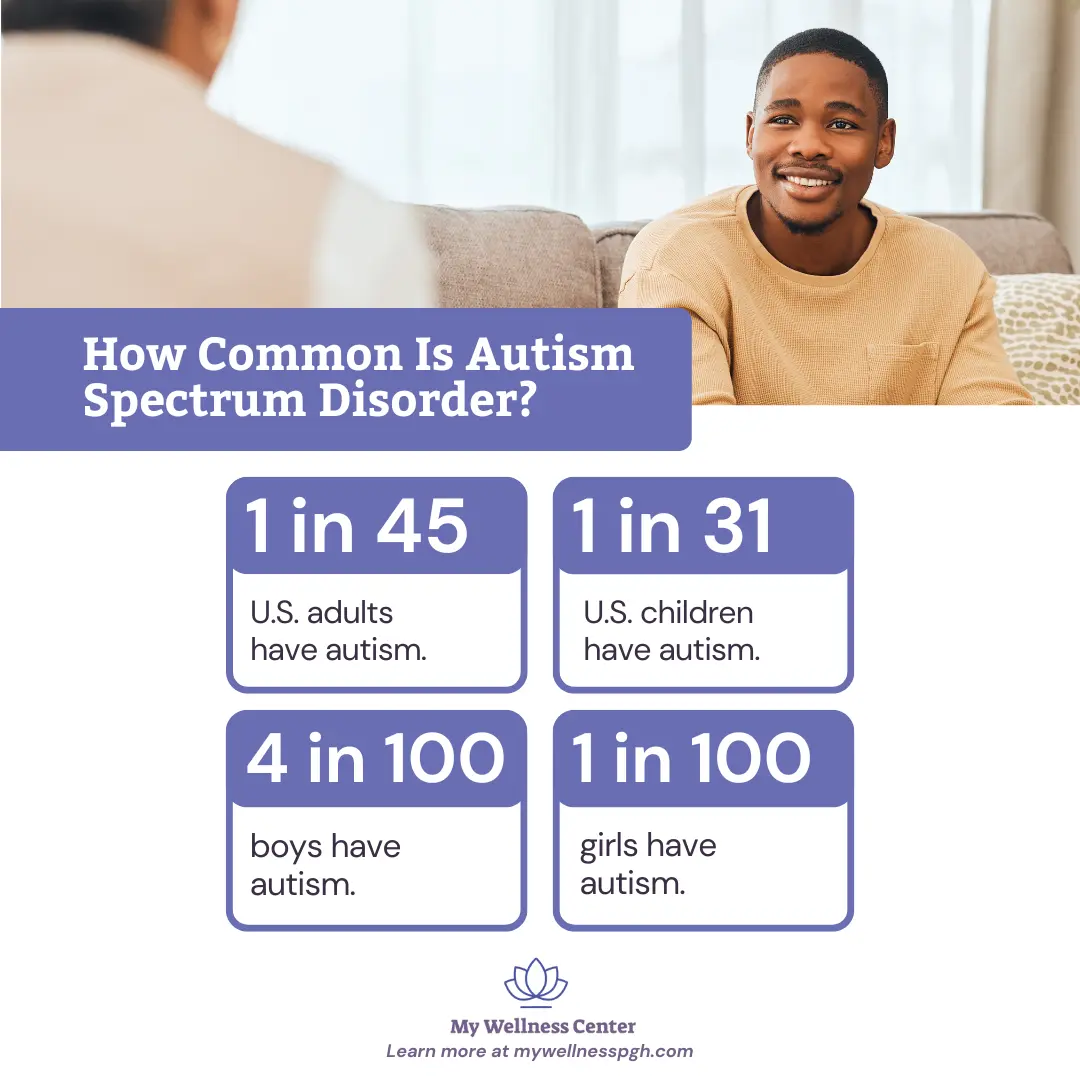
The number of diagnoses vary from year to year, but here are some of the latest estimates:
- 1 in 45 U.S. adults have autism.
- 1 in 31 U.S. children have autism.
- 4 in 100 boys have autism.
- 1 in 100 girls have autism.
Stepping back, that means roughly 2-3% of the population is living on the spectrum every day.
Why is therapy important for adults with autism?
Learning you’re on the spectrum as an adult can be a shocking revelation—but it can also feel reassuring. After all, many people who grow up with autism spectrum disorder suffer through a few challenges, including:
- Feeling like they never fit into their social groups or peer networks
- Having trouble developing friendships or romantic relationships
- Understanding social contexts and norms
- Managing physical and verbal tics
- Responding to bullying
- Dealing with punishments from authority at school or at home—often for behaviors outside of their control
- Exhaustion from “masking” your differences
Together, these symptoms can lead to lifelong traumas that can only be properly managed through therapy.
What are the signs of autism in adults?
The signs of autism in adults are similar to the signs we see in children—though they may be more nuanced. Some of the signs we notice include:
- Difficulty with social interactions, especially with eye contact, metaphors, and social cues.
- Intense hobbies often limited to one or two interests.
- Following strict routines, especially routines that are repeated every day (like how someone prepares for work).
- Stimming behaviors, such as tapping a foot or twirling hair.
- Sensory issues, such as difficulties with loud noises, bright lights, physical touch, or strong smells.
- Frequent exhaustion from working hard to “fit in”—often in ways that don’t feel natural.
The signs of autism can be different for men and women, partially because of biological differences but also because of the gender “norms” we expect to see in society.
Signs of Autism In Adult Women
Spotting autism in adult women and even little girls can be trickier than spotting ASD in males. As we mentioned earlier, society expects females to behave in a certain way, and some of the “tells” or masking behaviors may be misinterpreted as simple femininity.
Some additional telltale signs of autism in adult women may include:
- Stims like twirling hair around a finger or playing with jewelry.
- Trouble forming or maintaining friendships, often preferring one-on-one interactions with close friends or forming short-lived friendships.
- Obsessive interests in research or hobbies, even around celebrities, pop culture, or other subjects.
- Emotional regulation. Many people with ASD struggle with understanding emotions and controlling outbursts. For women with ASD, however, this could be labeled as simply being “overly emotional.”
- Anxiety and depression. Not all people on the spectrum suffer from anxiety and depression, but women who work to hide their ASD symptoms may experience higher rates of anxiety, depression, and even suicidality.
Signs of Autism In Adult Men
Autism in men often shows itself through the more “traditional” hallmarks of ASD. According to MedicalNewsToday, some of the most common signs of autism in adult men include:
- Trouble with nonverbal cues
- Difficulty understanding relationships
- Repetitive behaviors
- Intense interests
- Sensory-seeking or sensory-avoiding behaviors
- Trouble with change
Remember: Everyone with autism spectrum disorder is unique, and not everyone has the same symptoms or intensity of symptoms.
What is high-functioning autism in adults?
“High-functioning autism” isn’t a formal clinical diagnosis—but it’s a term many adults use to describe their lived experience on the spectrum. In general, it refers to individuals with Autism Spectrum Disorder who have average or above-average intelligence and can manage many day-to-day responsibilities like work, school, and independent living.
That said, “high-functioning” can be misleading.
Many adults who are labeled high-functioning appear successful on the outside, but internally, they’re working incredibly hard just to keep up.
For these people, social interactions can feel exhausting, sensory overload can be constant, and anxiety, burnout, and feelings of isolation are common—especially after years of masking symptoms to meet social expectations.
Symptoms of High-Functioning Autism In Women
Women with high-functioning autism are often diagnosed later in life—or not at all—because their symptoms can be more subtle or better masked. Common experiences may include:
- Strong social masking skills, such as rehearsing conversations or mimicking others’ behaviors
- Chronic exhaustion or burnout from “keeping it together” socially
- Heightened anxiety, perfectionism, or people-pleasing tendencies
- Difficulty identifying or expressing their own needs and emotions
- Deep empathy paired with emotional overwhelm
- Sensory sensitivities that are hidden or internalized
Many women come to therapy after years of feeling “different,” misunderstood, or emotionally drained—finally realizing there may be a reason why life has felt harder than it looks for others.
Symptoms of High-Functioning Autism In Men
Men with high-functioning autism may show symptoms that align more closely with traditional descriptions of ASD, such as:
- Direct or literal communication styles
- Difficulty navigating emotional intimacy or vulnerability
- Intense focus on specific interests or routines
- Challenges with flexibility, transitions, or unexpected change
- Sensory sensitivities that affect work or relationships
- Social withdrawal following overstimulation or stress
While these individuals may appear confident or self-sufficient, many struggle silently with loneliness, frustration, or emotional regulation.
Why is therapy for adults with autism so important?
For many adults on the spectrum, therapy isn’t about “fixing” autism. Instead, it’s about healing, understanding, and self-acceptance.
Adults with autism are more likely to experience:
- Chronic anxiety and depression
- Social rejection or bullying trauma
- Relationship difficulties
- Workplace stress or burnout
- Identity confusion after a late diagnosis
Therapy offers a space where adults can finally feel understood without needing to mask, perform, or explain themselves. It helps individuals reframe past experiences, build coping tools, and create a life that works for them—not one that constantly feels out of reach.
What happens in therapy for adults with autism?
Therapy for adults with autism is highly individualized. At My Wellness Center, we focus on meeting you where you are—emotionally, cognitively, and socially.
Depending on your needs, therapy may include:
- Processing past experiences or trauma, especially related to bullying, rejection, or late diagnosis
- Developing emotional awareness, including identifying feelings and understanding internal cues
- Improving communication and relationship skills in a way that feels authentic—not forced
- Managing anxiety, depression, or burnout using evidence-based approaches
- Building routines and coping strategies for sensory overload and daily stressors
- Exploring identity and self-acceptance, particularly after years of masking
Most importantly, therapy provides a judgment-free environment where your neurodivergence is respected—not pathologized.
You don’t need to change who you are to thrive. With the right support, you can better understand yourself, strengthen your relationships, and move through the world with greater confidence and compassion—for yourself most of all.
Find A Therapist For Adults With Autism
If you’re ready to dive into therapy for adults with autism, contact us. Our compassionate team of therapists are standing by to give you the support you need to successfully navigate the world around you.