

Article Summary: There are three major types of attachment disorders in adults: Disorganized, Anxious, and Avoidant. Through therapy, adults can reach Secure Attachments—healthy relationships that boost mood, self-esteem, and overall wellbeing.
When we’re kids, we think adults have it all together. But when we become adults, we realize a sad truth: Adults have even bigger problems.
That’s true even in relationships. In fact, we often see clients for attachment disorders in adults—disorders that often stem from childhood traumas and interfere with forming healthy relationships with the people around us.
Adult attachment disorders are frustrating—but they can be overcome. Through therapy, you can discover new revelations about yourself and build critical skills that help you connect with the people around you.
Read our full blog to learn more!
Table of Contents
3 Types of Attachment Disorders In Adults
Where do Adult Attachment Disorders Come From?
How to Treat Attachment Disorders In Adults
Achieving The Ultimate Goal: Secure Attachment
Find A Pittsburgh Adult Attachment Disorder Therapist
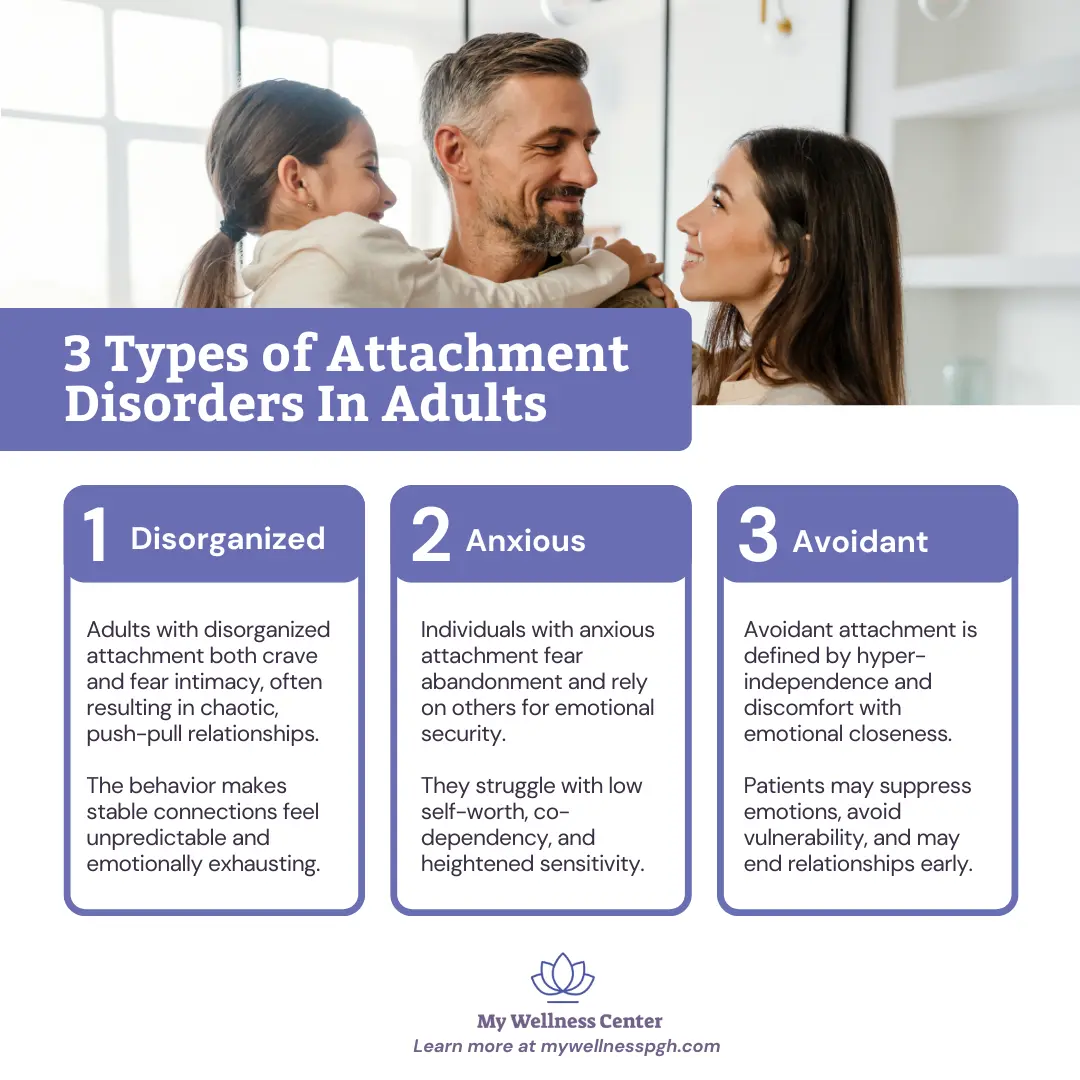
3 Types of Attachment Disorders In Adults
We typically separate adult attachment disorders into three separate types, as we’ll discuss below:
1. Disorganized Attachment Disorder
Disorganized attachment disorder is especially frustrating for those who suffer from it. These adults want close relationships, but they’re also afraid of it, which causes them to keep people at a distance.
In many ways, a disorganized attachment disorder can mimic borderline personality disorder, where relationships are unstable and intense, and an individual often seems impulsive. You might hear someone with a disorganized attachment disorder say, “I love you! Come here.”… only to soon turn around and say, “I hate you! Go away!”
Common Signs of Disorganized Attachment Disorder
- Trouble managing strong emotions (“hot-headed”)
- Fear of intimacy
- Fear of abandonment
- Trouble trusting others
2. Anxious Attachment Disorder
Adults with anxious attachment often grow up feeling unsure of their worth and deeply fearful of abandonment. They seek closeness intensely, but they also worry that the people they love will one day leave them. This leads to hypervigilance in relationships, heightened emotional sensitivity, and an almost constant need for reassurance.
Adults with anxious attachment may struggle with low self‑esteem, co‑dependency, jealousy, and difficulty being alone. They often interpret small shifts in tone or behavior as signs of rejection, making even stable relationships feel emotionally overwhelming.
Common Signs of Anxious Attachment Disorder
- Co-dependency on others
- Trouble being alone or independent
- Low self-worth
- Deep fear of abandonment
- Heightened sensitivity
3. Avoidant Attachment Disorder
If anxious attachment disorder is all about being as close as possible to others, avoidant attachment disorder is all about staying as far away as possible.
Individuals with avoidant attachment disorder are often labeled “hyperindependent”—a deeply rooted need for self-reliance that can prevent them from asking for help when they need it.
This sort of self-reliance is rooted in a fear of close relationships, and it can prevent those relationships from ever forming in the first place. Individuals with avoidant attachment disorder have trouble trusting others—even in romantic relationships—and it’s common for them to stonewall, avoid tough conversations, and even end romantic relationships suddenly.
Common Signs of Avoidant Attachment Disorder
- Depression and anxiety
- Trouble making friends or maintaining friendships
- Difficulty trusting others
- Hyperindependence
- Suppressed emotions
- Emotional distance
Where do Adult Attachment Disorders Come From?
Adult attachment disorders frequently come from the same place: childhood trauma. In many cases, a caregiver was inconsistent in their treatment—providing a source of love and a source of fear. Sadly, these parents may have suffered from severe mood swings, or they may have been loving one day and abusive the next.
This constant pendulum swing of behaviors creates deep-seated fear and distrust, and it often transforms into one of the three forms of attachment disorder we discussed above.
How to Treat Attachment Disorders In Adults
Therapists commonly use a variety of techniques to treat attachment disorders. Five of the most common strategies:
1. Psychoeducation
Psychoeducation helps individuals understand their attachment style, where it originated, and how it affects their thoughts, emotions, and relationships today. This understanding alone can reduce shame and create a sense of clarity, control, and perspective.
Therapists may also guide clients through identifying negative beliefs about relationships—such as “I’m unlovable” or “People always leave me.” By recognizing these patterns, clients can start replacing them with healthier, more realistic beliefs.
2. Cognitive Behavioral Therapy (CBT)
CBT is especially helpful for avoidant attachment, where individuals often rely on emotional suppression and distancing strategies. Through CBT, clients learn how to challenge unhelpful thoughts about intimacy, vulnerability, and trust.
They practice new behaviors—like expressing needs or staying engaged during conflict—instead of shutting down. Over time, CBT helps rewire long-held patterns that keep relationships shallow or unstable.
3. EMDR (Eye Movement Desensitization and Reprocessing)
We love EMDR at My Wellness Center, and we’ve experienced firsthand its transformative healing power.
In instances of attachment disorder, EMDR addresses the root of the wounds by targeting early memories of neglect, fear, inconsistency, or emotional abandonment.
As these memories become less emotionally charged, clients experience more emotional stability and a greater capacity for intimacy. EMDR can also increase self-awareness and reduce the overwhelming reactions that come with insecure attachment.
4. Solution-Focused Therapy
Solution-focused therapy emphasizes strengths, possibilities, and small, actionable changes rather than dwelling on what’s wrong. Clients learn to envision what secure attachment would look like in their daily lives and identify immediate steps toward it.
Therapists help clients build on existing successes, reinforcing confidence and agency. This approach creates momentum—and promotes hope—which is key for individuals trying to break longstanding attachment patterns.
5. Practicing Vulnerability
Practicing vulnerability is essential for healing attachment wounds, especially for those who learned that closeness leads to pain. Therapy provides a safe environment to explore what vulnerability actually means and how it feels in real time.
Over time, clients experiment with sharing thoughts, needs, and emotions in healthier ways—both in therapy and in relationships outside of it. As these experiences accumulate, individuals develop a felt sense that intimacy can be safe, stable, and deeply fulfilling.
Achieving The Ultimate Goal: Secure Attachment
A secure attachment style is characterized by a healthy sense of self‑worth, comfortable intimacy, and the ability to trust others. Adults with secure attachment tend to experience better emotional regulation, stronger relationships, and higher psychological well‑being.
Therapy for adult attachment issues aims to help individuals shift from insecure or disorganized attachment toward more secure ways of relating, internally and externally.
Find A Pittsburgh Adult Attachment Disorder Therapist
Our Pittsburgh therapists are ready to help you tackle your adult attachment disorder. Contact us today to get started.