We’re all taught that adoption is beautiful, that it’s the growth of a loving family and a second opportunity for an individual. But adoption is also painful. Since it often stems from an act of abandonment, many adoptees struggle with their mental health—and there are many signs of adoption trauma in adults.
Therapy can help. By identifying the symptoms, addressing the trauma, and working toward healing, adoptees can live happier, healthier lives.
And we have proof right here in our office. Associate Therapist Allie Greene was adopted as a newborn, and her childhood, teen years, and early adulthood were filled with anger, frustration, substance abuse, and confusion.
She’s shared some of her story to help us develop this article.
Table of Contents
6 Signs of Adoption Trauma In Adults
- Trouble Forming or Maintaining Relationships
- Unexplained Feelings of Anger, Frustration, or Sadness
- Depression And Anxiety
- Substance Abuse
- Constantly Chasing Perfection
- Reactive Attachment Disorder
Find A Therapist for Adult Adoptees
6 Signs of Adoption Trauma In Adults
A major study in the 1980s identified seven core, lifelong issues for adoptees. These included:
- Loss – Adoption is, after all, a result of loss.
- Rejection – Many adoptees feel like they were abandoned or rejected by their birth parents.
- Guilt and shame – Many adoptees believe there is something wrong with them that caused their birth parents to give them up.
- Grief – Grief is a natural extension of loss, as an adoptee mourns the relationship they’ll never have with their birth parents.
- Identity – Leaving one family and joining another can lead to an identity crisis.
- Intimacy – Adoptees regularly struggle to form close bonds with their adoptive families, classmates, co-workers, and others.
- Mastery/control – Most children don’t have the opportunity to choose adoption, which is a major, life-altering process. This can lead to feelings of helplessness and lowered self-worth.
These are common themes that often contribute to the signs of adoption trauma we’re discussing today.
But there are others as well. One study found 62% of children in the foster care system are there because of abuse or neglect. If you’ve grown up in an abusive household, you could face lifelong challenges to your mental health without visiting an experienced therapist.
Related Reading: Family Therapy Frequently Asked Questions
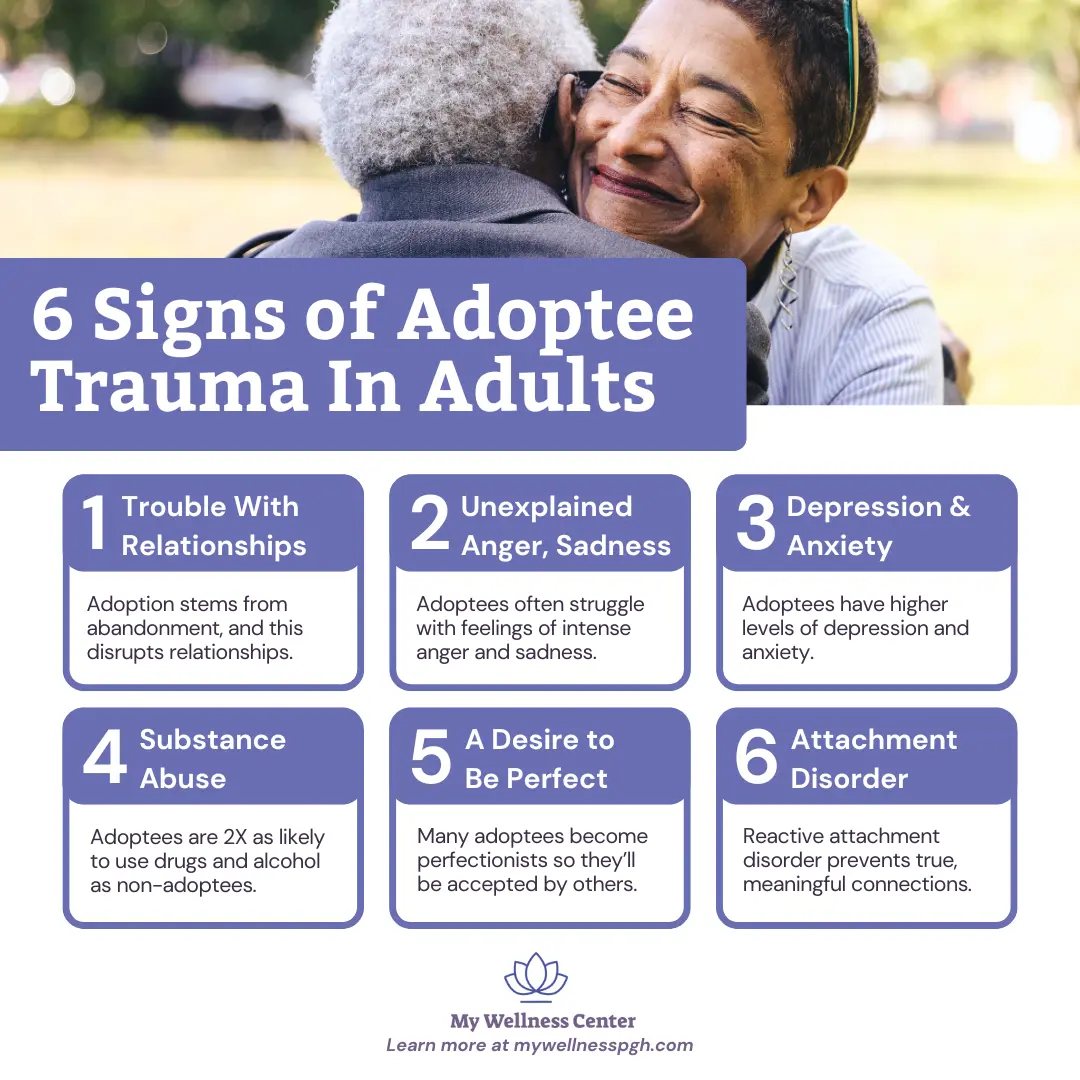
1. Trouble Forming or Maintaining Relationships
There’s plenty of beauty in adoption, but it always stems from an act of abandonment—and that’s not always easy to overcome.
“The nine months we spend in the womb is a relationship,” Associate Therapist Allie Greene says. “It’s the first relationship we have. We hear our mother’s voice, her body, and her heartbeat. When we’re suddenly separated from that, we lose a nine-month relationship and are sometimes passed from incubator to stranger to cradle to new strangers… In that confusing state, our only thought is often, ‘I am going to die.’”
For children who grew up in the foster care system, forming new relationships can be challenging, especially if a child has bounced around from home to home. As a protective mechanism, many learn to think, “Well, I’m just going to leave again, so I shouldn’t bother trying to form a new relationship with these people.”
2. Unexplained Feelings of Anger, Frustration, or Sadness
Many adult adoptees struggle with strong, unexplained negative emotions—such as anger, frustration, or even sadness.
Associate Therapist Allie Greene says she struggled with this throughout childhood and adulthood until she read The Primal Wound: Understanding the Adopted Child.
“Nancy Verrier writes how her adopted daughter would get sad every year around her birthday, and I thought, ‘Oh, my God… That’s me! It’s my body remembering the trauma I went through as a baby when I was separated from my mother.’ It validated my emotions and confirmed so much of what I’d already suspected.”
Not all emotional overload for adoptees works on a schedule, though. As Associate Therapist Allie Greene explains later in this article, these feelings can be constant and overwhelming—which can then contribute to feelings of depression and anxiety.
Related Reading: Therapy For Grief And Loss
3. Depression And Anxiety
Research shows adoptees exhibit higher levels of anxiety and depression than their peers—as well as higher rates of oppositional behavior, hyperactivity, and inattentiveness.
These feelings are challenging enough in childhood, but they’re even more frustrating as an adult, when you’re expected to hold responsibilities at work and within your family life.
Sadly, suicide risk for adoptees is four times higher than it is for non-adoptees—but therapy can help.
4. Substance Abuse
Research shows adoptees are nearly twice as likely to abuse drugs and alcohol as non-adoptees.
As Associate Therapist Allie Greene recalls, “I was into everything as a teenager. I didn’t want to feel. I was really, really angry, and I didn’t know why.”
Of course, substance abuse only masks internal and external problems, and it does nothing to actually fix the problems.
5. Constantly Chasing Perfection
Adoptees are sometimes perfectionists, and for good reason. As Associate Therapist Allie Greene explains: “You learn in your nervous system to be perfect so you’re not abandoned again.”
As a child, perfectionism can show up in school with perfect grades, in sports by constantly pushing yourself ahead of others, and in extracurricular activities by devoting extra hours to practice.
As adults, we see perfectionism show up through performance at work, the way you dress, and even the way you behave in front of other people.
Unfortunately, chasing “perfect” is an illusion; nobody is perfect. As a result, perfectionists often feel anxious, depressed, and burned out by their constant efforts.
6. Reactive Attachment Disorder
Reactive attachment disorder (RAD) is a frustrating disorder for everyone involved. RAD prevents children from seeking comfort in caregivers, and it can prevent real, emotional bonds from forming.
For adults, RAD can disrupt relationships with friends, family, co-workers, and romantic partners, cutting someone off from the rest of the world.
Some of the most common RAD symptoms include:
- Low self-esteem
- Anxiety
- Depression
- Self-harm
- Difficulty building meaningful relationships
Related Reading: Overcoming Attachment Disorders In Adults
Find A Therapist for Adult Adoptees
If you’re seeking therapy as an adult adoptee, contact us. Our team of compassionate therapists, which includes Allie Greene, is ready to help you navigate your past for a healthier, happier future.