

Article Summary: Pat McGowan, LPC is developing his dissertation and conducting research on the shared experience of therapists who have avoided therapy. Findings across peer-reviewed literature include time constraints, financial concerns, previous bad experiences, therapy-related stigmas, confidentiality, and pride.
We have tough jobs as therapists. In addition to helping others with their mental health struggles, we’re often stuck fighting a hidden battle inside our own minds and bodies:
Burnout.
It’s all too real among mental health professionals. In fact, a 2023 study from the American Psychological Association found 36.3% of psychologists are burned out, and it jumps up to a whopping 57.3% for psychologists who are in the first 10 years of their career.
While all of us know therapy can be helpful, therapists, counselors, and psychologists are often reluctant to adopt it for themselves.
My Wellness Center Counselor Pat McGowan is currently researching and writing his dissertation to discover their shared experience. Continue reading to learn more.
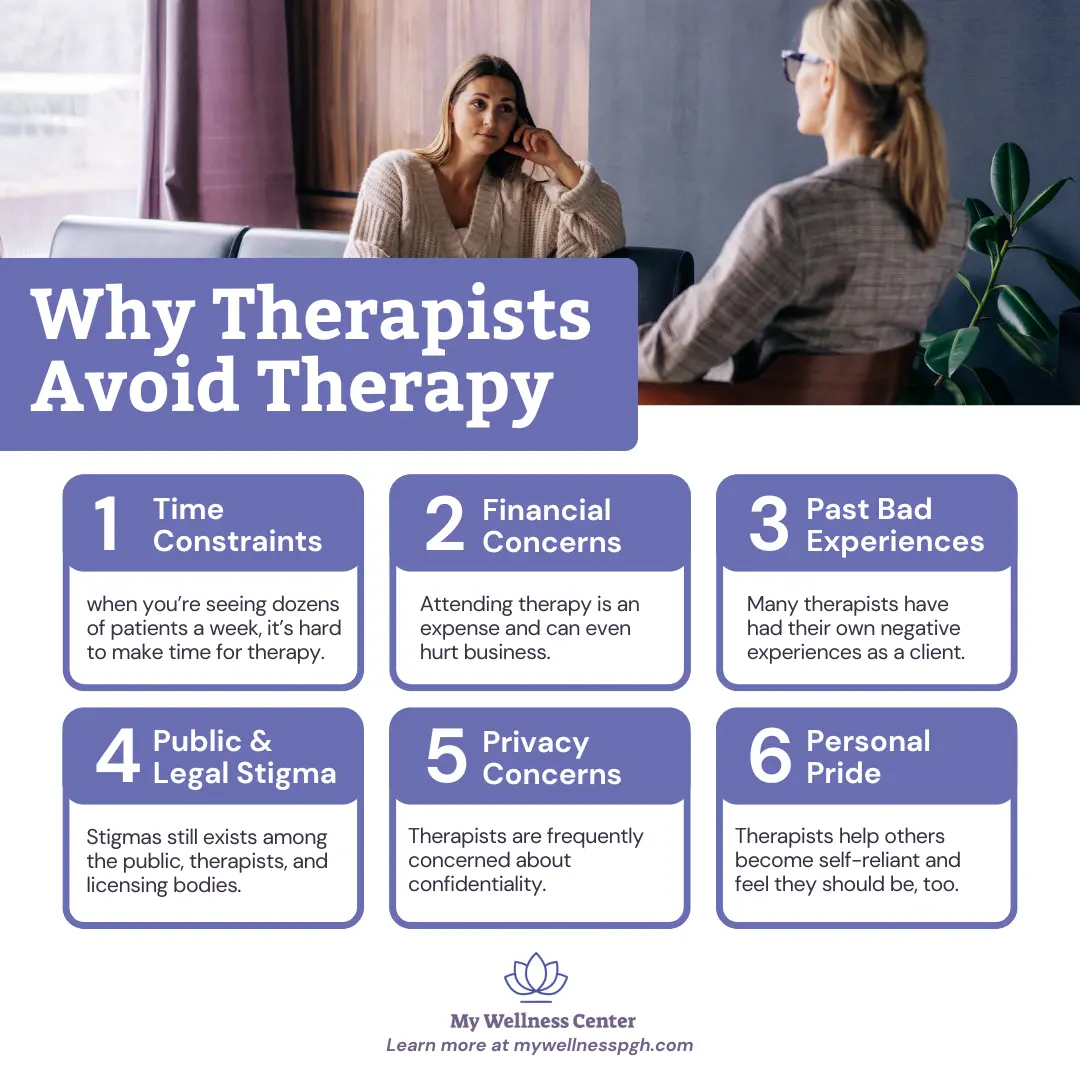
Table of Contents
Research: 6 Common Reasons Why Therapists Don’t Go to Therapy
How to Revitalize Your Therapy Career
FAQs
Research: 6 Common Reasons Why Therapists Don’t Go to Therapy
Based on peer-reviewed research, here are six of the most common reasons therapists give for not going to therapy:
1. Time
Perhaps the most obvious—and most cited—reason therapists don’t go to therapy is simple: they don’t have time. Between back-to-back sessions, paperwork, insurance claim disputes, client emergencies, CEU deadlines, and maintaining their own families or personal lives, there’s often little time left to address their own mental health.
Unlike other professionals, therapists can’t simply “leave work at work.” Emotional labor is embedded into their daily routines, and without spacious time blocks to decompress or reflect, the idea of fitting in a weekly therapy session can feel more like a burden than a benefit.
For private practice clinicians, the problem is compounded by a full calendar—if you’re seeing 25+ clients per week, scheduling even one hour for your own therapy might require giving up a client session (and income) or cramming it into an already overstretched day. And for those working in agencies or hospitals, scheduling flexibility may be minimal, with limited availability during standard hours.
Therapists often tell themselves, “I’ll make time when things slow down.” But the reality is, things rarely slow down. Without intentional calendar planning—and sometimes, a willingness to prioritize themselves like they would a client—therapy gets indefinitely postponed.
2. Financial Outcomes
Therapists commonly cite one of two reasons for avoiding therapy because of financial pressures:
-
- Therapy can be expensive, even for therapists. Paying for therapy out-of-pocket often costs more than $100 per session, which can quickly add up over the span of a year. Insurance can help, but not all therapists accept all forms of insurance.
- Attending therapy could hurt a therapist’s business. Research shows patients actually prefer working with therapists who aren’t in therapy. That’s true even if it means they would receive lower-quality care!
3. Previous Bad Experiences
Most therapists take multiple efforts to ensure their patients are as comfortable as possible during therapy sessions. Unfortunately, fellow therapists aren’t always afforded the same level of customer service.
Research shows therapists who’ve attended therapy occasionally complain of bad experiences, including:
- Incompetence – As a trained therapist, you know the proper steps to take during a session and how to use different modalities. So, it’s glaringly obvious when a fellow therapist is incapable of high-quality treatment.
- Unprofessionalism – Therapists are people too, and some of them aren’t as professional as we’d like for another colleague. We’ve heard and experienced our own horror stories over here (but, fortunately, not caused by our team!).
- Harassment – Sadly, sexual harassment came up multiple times as reasons for discontinuing therapy and be hesitant to return.
4. Stigma
The mental health industry is rife with stigmas from multiple angels. While therapy is more popular than ever, and companies like BetterHelp even spend a small fortune on ad campaigns, a certain layer of stigma still remains—especially among mental health professionals.
Here are some of the most common causes:
1. Asking for help betrays a therapist’s self-reliance. Therapists are often praised as mental superheroes for their patients, helping them through countless crises to grow into happy, healthy individuals.
That’s a good thing.
But it also leads some therapists to think there’s no possible way another therapist could help them through their problems. As we’ll discuss later, many even offer this retort: There’s nothing someone could tell me that I don’t already know or have access to through my current resources.
Overcoming this mental block is essential for seeking the support you need.
2. There’s still a perception of public stigma. As we mentioned earlier, patients prefer working with therapists who aren’t in therapy. That’s frustrating news for therapists looking for a little extra support.
3. Licensing language can create additional stigma. In Pennsylvania, for example, one of the application questions include:
“Do you currently have any physical or mental condition or disorder, including drug or alcohol addiction, that impairs or may impair your ability to practice safely and competently?”
As written, this question is vague enough to create conflict. What if someone has depression that they’re currently seeing a therapist and taking medication for? Sure, without medication and ongoing therapy, an individual might struggle in a professional setting. But by following the treatment protocols, this question seems like a non-issue.
So, what should someone do? Check No, and risk lying on their application? Or check Yes, and risk getting rejected from the career they’ve worked so hard for?
It’s not an easy challenge to face, and it’s enough to make some therapists hesitant to seek help for the rest of their career—especially if it means potentially losing their license.
5. Confidentiality
Confidentiality was an especially critical concern before the rise of telehealth and online therapy options.
But it’s still a major concern. Many therapists are reluctant to see someone with their professional network or even within their own community.
If you prefer live, in-person sessions, this could mean extensive travel time for a therapy session—which could create additional layers of complications just to improve your own mental health.
6. Pride
Pride is a quiet but powerful force in the therapy world—and it may be one of the most difficult barriers to overcome.
Therapists are trained to support others through vulnerability, shame, and struggle. They know how to normalize asking for help. But when it comes to their own struggles, many feel they should be able to handle things alone. After all, they have the tools. They’ve read the research. They’ve helped others climb out of darkness—so why can’t they do the same for themselves?
This internalized belief can morph into a self-imposed expectation of emotional mastery: “If I’m struggling, I must be doing something wrong.” And that’s where pride sneaks in—not in a boastful way, but in a quiet resistance to being on the receiving end of care.
In some cases, pride may also stem from fear of being “seen” by another clinician. What if their therapist notices signs of burnout? What if they don’t have all the answers? What if they break down? For many, the idea of losing professional composure is deeply uncomfortable.
But therapy isn’t about perfection—it’s about honesty. And ironically, the ability to ask for help isn’t a weakness. It’s a professional strength.
How to Revitalize Your Therapy Career
As therapists ourselves, we know the truth as well as anyone else: Burnout among therapists is rampant.
While ongoing therapy is critical to overcoming, managing, and preventing burnout, there’s another solution that can have wide-ranging benefits:
Therapist CE retreats. These restorative professional development excursions blend self-care and ongoing education, leaving you rejuvenated, focused, and ready to jump back into your career.
That’s why we started My Wellness Retreats, our sister company that focuses exclusively on high-quality therapist retreats.
Book a retreat today to start your healing journey and overcome that dreaded burnout.
FAQ: Therapy And Therapists
Why do therapists avoid going to therapy?
Six of the biggest reasons therapists avoid therapy are time, finances, previous bad experiences, stigma, confidentiality concerns, and pride.
What’s a strong alternative to therapy for therapists?
While we always advocate for attending therapy, therapist CE retreats can provide a strong boost for your mental and physical health.
Where should therapists go to therapy?
We welcome all therapists to contact us at My Wellness Center. We’d be happy to help you on your mental health journey.